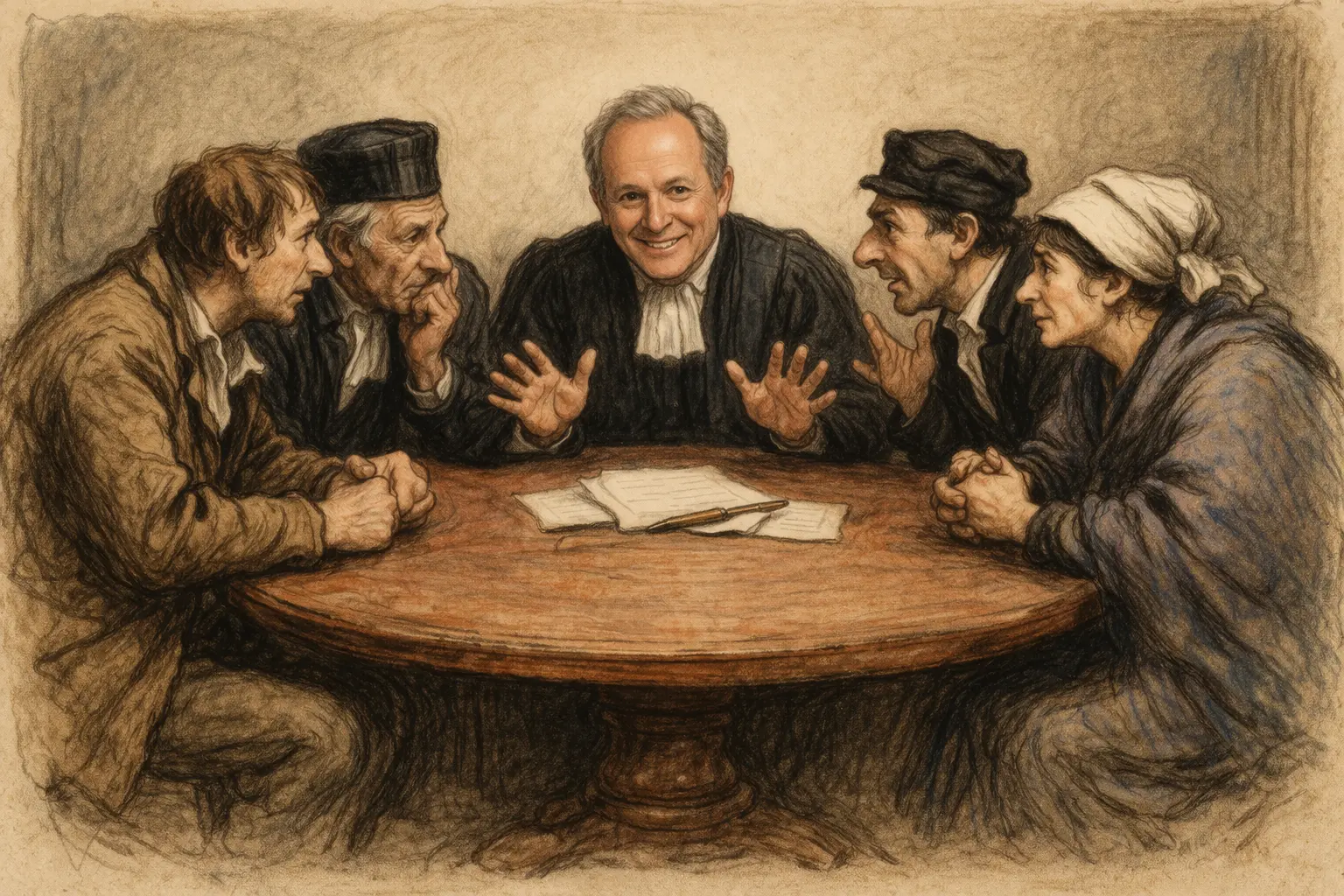
International Arbitration: The Pig War And ADR
The Pig War And Alternative Dispute Resolution
During the month of August I hiked in the San Juan Islands, which lie in the Salish Sea between Vancouver and Washington State. On San Juan Island, I learned about the Pig War, a historical event that involved international arbitration of a dispute between Britain and the United States. It presents an opportunity to discuss dispute resolution in an international context.
Death of a pig. In 1859, Lyman Cutlar, an American settler on San Juan Island, whom the British would have considered a squatter, objected that a British pig was foraging in Cutlar’s vegetable garden. Cutlar threatened to shoot it if it returned. The pig belonged to Charles John Griffin, an agent of the Hudson’s Bay Company. The Company, which ran a large sheep farm on the island, was established to stake a British presence and claim to the island.
The hungry pig returned to forage and Cutlar shot it dead.
Tiered dispute resolution. Cutlar attempted a voluntary resolution of the dispute. He offered $10 to Griffin, who rebuffed him, insisting on payment of $100. Legend has it that Cutlar told Griffin that the pig was eating his potatoes, and Griffin replied “It is up to you to keep your potatoes out of my pig.” I suspect that is an American version of their conversation.
Impasse and escalation. Presumably the “pound sand” positions taken by Cutlar and Griffin created a negotiation impasse. The result was an escalation of the incident into an international conflict. The British brought Royal Marines to the Island and threatened the American settlers, who requested and obtained military protection. A British camp was garrisoned on the north of San Juan Island, and American troops camped on the south of the island.
At issue was not just whether San Juan Island belonged to Britain or the United States, but whether the San Juan Islands archipelago belonged to Britain or the United States. The main islands are San Juan, Orcas, Shaw, and Lopez.
Preservation of the status quo. General Winfield Scott was dispatched to resolve the dispute. Supposedly British Rear Admiral Robert L. Baynes insisted that Britain would not escalate the conflict over a squabble about a pig. The status quo was preserved by agreement that British Royal Marines and United States troops could camp on San Juan Island until the dispute was resolved, and they would not engage in fighting. Thus reason prevailed.
As a historical aside, by the time of the Pig War, General Scott, always a large man, weighed 400 pounds. To get aboard the ship that would take him to San Juan Island, General Scott had to be hoisted aboard by commercial crane. Old and in ill health, General Scott did not want to repeat that painful and surely humiliating experience. He never set foot on San Juan Island, using instead an intermediary to communicate with British Governor James Douglas, with whom he successfully negotiated a joint occupation agreement.
Two other notable United States army men played a role. Second Lieutenant United States Army Engineer Henry Martyn Robert oversaw the design and construction of fortifications known as “Robert’s Redoubt.” Today, Robert is much better known as the author of Robert’s Rules of Order. Captain George Pickett commanded the troops on San Juan Island. But today, he is far better known for leading the disastrous and eponymous Pickett’s Charge during the Battle of Gettysburg.
Civility. During the period of joint occupation, the military forces socially mingled, playing athletic games together, eating together, and observing national holidays. When there is a path to dispute resolution, adversaries need not act as enemies. No doubt the friendly forces consumed large amounts of alcohol during their stay on San Juan Island, and perhaps this explains one unintentional homicide. A poignant tombstone in the tiny English cemetery on San Juan Island reads, “Sacred to the memory of William Taylor Aged 31 years Who was accidentally shot By his Brother June 26th 1868 This Tablet is erected by His Sorrowing Brother.”
The pig was the only intentional fatality. When asked who ate the pig, guides on the island will say that’s the first question visitors always ask, but they do not know the answer to the question.
Agreement to an Arbitration Process. Further negotiations occurred and it was agreed in 1871 to assign the territorial dispute to an arbitrator, Kaiser Wilhelm I of Germany.
Experts. As the arbitrator, Kaiser Wilhelm I relied on a panel of three experts. The three distinguished experts included Heinrich Kiepert, a geographer, Levin Goldschmidt, a legal scholar, and Ferdinand Grimm, a judge. The three experts had to apply ambiguous language in the 1846 Oregon Treaty to the facts and decide whether the boundary lay to the east of the San Juan Islands, in which case the islands would belong to Britain, or to the west, in which case the islands would belong to the United States. The United States argued that Haro Strait, to the west, was the boundary, and Britain argued that Rosario Strait, to the east, was the boundary.
The language of the 1846 Oregon Treaty was ambiguous, for it provided that the border would run through the middle of the channel which separates the continent from Vancouver Island. The San Juan Islands are in the middle between the two straits, and it was unclear whether the “channel” was the Haro Strait, the Rosario Strait, or what we now call the Salish Sea, the waters that surround the islands. Kiepert and Grimm voted in favor of Haro Strait, which would give the islands to the United States. But Goldschmidt dissented, believing that the channel meant all the waters – a Solomonic opinion that would have been a compromise, and resulted in splitting the islands between Britain and the US.
Baseball arbitration. In what can be characterised as an early example of Baseball Arbitration, in which each side states its position, and the arbitrator must choose between the two, Goldschmidt’s compromise solution was foreclosed by the agreed-to ground rules for the arbitration. The arbitrator had to choose the Haro Strait or the Rosario Strait as the territorial boundary. The majority position that the boundary lay to the west of the islands prevailed, and the arbitrator awarded the San Juan Islands to the United States.
In a time of manufactured conflict between the United States and Canada, it is gratifying to know that the Pig War was peacefully resolved by parties acting reasonably, following a rational dispute resolution process, and desiring peace rather than ruinous conflict.

English Camp. Captain Delacombe’s garden.

American Camp.
Disclosure: Arbitration Award Is Vacated Because Arbitrator Did Not Disclose Participation In Firm-Sponsored Webinar
Reasonably Entertaining A Doubt About Impartiality?
I usually do not post about Superior Court cases. However, after taking off time in August to, among other things, hike in the San Juan Islands, I read upon my return about Hall v. Elden Investments, LLC, LA County Superior Court Case No. 26STCP01203. It’s an interesting case deserving attention.
Hall received a favorable award from a San Diego arbitrator, requiring the return to Hall of a $132,265 deposit due as a result of a breached real estate purchase agreement, plus interest, costs, and attorney’s fees. Hall moved as Petitioner to confirm the award in LA County Superior Court. However, the judge denied the petition to confirm, and granted a cross-petition to vacate the award instead.
Why? The arbitrator had not disclosed her participation in a webinar sponsored by Petitioner’s law firm, after issuing an interim award, but before a final award. The judge described the webinar as a “firm-sponsored firm-branded event” burnishing the reputation of the arbitrator and the law firm. Concluding that the issue was not whether there was actual bias, but rather whether a reasonable person could entertain doubts about the arbitrator’s impartiality in the case, the judge vacated the award.
COMMENT: Without expressing an opinion about the correctness of the decision, I note that arbitrators, mediators, and attorneys routinely participate in educational webinars sponsored by law firms. Also, large law firms are often MCLE providers, and therefore frequently sponsor such webinars. Participants are most likely to participate with others with whom they have professional and organizational relationships. If judicial treatment of such webinars as “firm-branded firm-sponsored events” requires disclosures, participants will need to keep conflict checks and disclosures in mind, and some participants will find themselves unable to participate.
Miscellaneous: Marc Has Article On Birthright Citizenship Case in DJ
Marc Alexander has an article in the July 7, 2026 Daily Journal discussing the U.S. Supreme Court’s recent opinion in Trump v. Barbara, which reaffirmed the principle of birthright citizenship.
Daily Journal articles are behind a paywall. Marc reviews the various opinions and underscores that, as to the constitutional holding affirming the existence of birthright citizenship, the vote was 5 to 4. Thus, an interpretation of the 14th amendment once viewed as far-fetched is now endorsed by four members of the Supreme Court.
The article asks: “Does Trump v. Barbara teach us anything about originalism as a doctrine of constitutional interpretation?”
And it suggests an answer: “Yes. Judges claiming to be originalists can reach diametrically opposed conclusions. Judges claiming to be originalists can cherry-pick and accuse judges with whom they disagree of cherry-picking. And originalists can address social concerns and questions of policy when it suits them.”
Miscellaneous: A Mediator’s Perspective of the M.O.U. Between the US and Iran
The Mediator’s Perspective.
In 2017, I reviewed the film The Journey for the Daily Journal. That film is about the negotiations that led to the Good Friday Agreement, putting an end to The Troubles in Northern Ireland. While our blog is focused on California mediation and arbitration, another opportunity to opine about negotiations from a mediator’s perspective seemed to good to pass up. The Memorandum of Understanding between the United States of America and the Islamic Republic of Iran presents that opportunity.
The full text of that MOU can be found here. But if the link breaks, you can easily find the text by googling the MOU. When I say that I will approach the MOU from a mediator’s third-party point of view, I mean here that I will not evaluate the substantive merits, but that I will focus on negotiation problems, such as not having all affected parties “at the table”, ambiguities, delay and impasse, and enforcement.
I will begin by reviewing each of the 14 points of the MOU with those background issues in mind. In a second part of this post, I will consider arguments that a defender of the MOU could advance for signing it. I have also made use of Claude Opus 4.8 to assist in the review of the MOU. Having provided a link to the MOU, I will not repeat the full text of the MOU.
Three problems are apparent throughout the text. First, the MOU is a two-party deal with absent stakeholders, such as Lebanon, Oman, other Gulf states, the IAEA, the UN Security Council, and unnaned regional parties. Second, most of the hard points are pushed off to a final deal. Third, the monitoring is weak. A mechanism is eventually to be set up, but nothing is said about what happens when someone breaks a promise.
Turning to each paragraph:
Par. 1 — Ceasefire on all fronts. But “all fronts,” “the current war,” and “their allies” are undefined. Lebanon is not a party, and parties that guarantee its sovereignty aren’t identified or signatories. The status of the ceasefire is unclear if a permanent deal does not occur.
Par. 2 — Mutual respect and non-interference. “Interfering in internal affairs” is vague — could mean proxy support, sanctions, broadcasting misinformation and propaganda, cyber activity, funding. Enforcement? Breach will be easy to allege and difficult to settle. Third parties who might interfere are not signatories.
Par. 3 — Final deal within 60 days, extendable by consent. Short time for big issues (sanctions, nuclear deal, $300B investment, asset release). Sixty days is extendable by mutual consent, so either side could torpedo extension.
Par. 4 — US lifts blockade in 30 days, pulls back forces 30 days after final deal. US undertakes to remove forces from proximity to Iran, but “proximity” is undefined. Sequencing: forces withdraw 30 days after final deal, but by then, some concessions may already have been made, and US forces don’t have to leave if there is no final deal.
Par. 5 — Iran ensures safe passage; talks with Oman on Strait of Hormuz. But Oman is not a signatory. Delay: demining “within 30 days” is technical and weather-dependent. Enforcement: “best efforts” to ensure safe passage is vague and failure does not carry clear penalty.
Par. 6 — Reconstruction plan of at least $300B. Missing parties: who will provide the money? No one is on the hook to pay and US has no obligation to fund. Scheduling: “develop a definitive plan with at least $300B” does not set forth a schedule.
Par. 7 — US terminates all sanctions, including UN and International Atomic Energy Agency measures. Missing parties: UN and IAEA. Release of some US sanctions may require legislation. US and Iranian “intention to immediately address these issues in the negotiations in order to achieve mutual agreement” is an intention, not an obligation.
Par. 8 — No nuclear weapons; handling enriched material; enrichment “to be discussed.” A key issue is deferred: a nuclear deal. The IAEA has a role in supervising nuclear enrichment, and it is not a party. Another enforcement issue: Iran “reaffirms it shall not develop nuclear weapons” is a statement of intention, not an inspection regime.
Par. 9 — Hold the status quo while negotiating. Vagueness: the “current status quo of its nuclear program” is not defined by date or any measures. Possibility for engendering future conflict as each side accuses the other of violating the status quo.
Par. 10 — Treasury waivers for Iranian oil exports. Missing parties? Whether oil flows may depend on third-party buyers, banks, insurers, and shippers who are cautious.
Par. 11 — Release of frozen Iranian funds. Missing parties, to the extent the funds are held abroad by third parties. The US undertakes to make funds available “upon the implementation of this MOU.” But there is no defined trigger for “implementation of this MOU.” And “procedures … agreed during negotiation” don’t exist yet.
Par. 12 — A mechanism to monitor compliance. Enforcement issue: an agreement to create a mechanism to monitor implementation of the MOU and future compliance leaves the compliance mechanism undefined. And monitoring is not enforcement.
Par. 13 — Talks on everything else depend on the early items being implemented. Because continuing negotiations are “subject to the beginning . . . and continuing implementation” of Paras. 1, 4, 5, 10, and 11, either side could create an impasse by claiming an early item has not been implemented.
Par. 14 — The final deal will be endorsed by a binding UNSC resolution. But the UN is not a party.
So what might an advocate of the MOU advance as arguments for signing it? They might acknowledge problems with implementation, while arguing that’s the price of getting any agreement. (Note that an MOU is not an agreement. The MOU here is more a statement of intention and an agreement to agree).
- BATNA: Best Alternative to a Negotiated Agreement. The advocate would argue that the best alternative to the MOU is ongoing violence.
- An MOU is a framework, so vagueness and deferral to a final deal are to be expected.
- The sequencing is smart. Build up momentum by addressing the easier problems, while deferring the harder issues.
- Reversibility protects the cautious signer. Waivers and licenses can be clawed back, providing an incentive to the order side to perform.
- The 60-day deadline concentrates minds and forces decisions.
- Freezing the status quo is better than the alternative; a loose definition of a freeze is better than escalation.
- Naming the IAEA carries the possibility of monitoring and verifying compliance.
So the advocate must argue that the loopholes are the necessary cost of having the possibility of a deal.
Will diplomacy breakdown? This will depend on the qualities necessary for a successful mediation: good faith, trust, and perseverance. Those qualities appear to be in short supply. Additionally, the parties need to see that a deal serves their substantive interests, an issue that I have not addressed.
Automobiles, Burden Of Proof: Consumer Compelled To Arbitrate
The Opinion Clarifies Shifting Burden Of Proof For Motions To Compel Arbitration.
The California Court of Appeal reversed a trial court’s denial of a motion to compel arbitration in a lemon law/warranty dispute. Kostandian v. American Honda Motor Company, B345489, (2/2 , pub. 5/27/26) (Chavez, Richardson, Gilbert).
Where a moving party meets its initial burden of establishing an arbitration agreement by producing a copy or reciting its terms verbatim, the burden shifts to the opposing party to dispute the agreement’s existence. If the opposing party fails to raise such a dispute, the motion to compel must be granted. The court applied this framework to both the lease arbitration clause (as to Standard Motor) and the warranty booklet arbitration agreement (as to American Honda Motor).
The court also held that a plaintiff’s own complaint allegations constitute judicial admissions that can satisfy a defendant’s prima facie burden.
COMMENT: Why publish? The opinion clarifies the burden-shifting framework for motions to compel arbitration, particularly regarding “Doing Business As” named parties and warranty booklet arbitration agreements, issues that arise in consumer vehicle litigation.
The DBA issue matters in arbitration disputes because a party seeking to compel arbitration must show it is actually a party to the agreement. If the agreement is signed under a trade name, a court may question whether the legal entity behind that name has standing to enforce it. California’s fictitious business name statutes govern DBA registrations, and Kostandian argued those statutes imposed an additional evidentiary burden on Honda, an argument the court rejected.
Kostandian himself had alleged in his complaint that “Standard Motor is doing business as Acura of Los Angeles Westside,” which constituted a judicial admission.
Add Your Heading Text Here
Supreme Court Holds Transport Worker Is Exempt From Arbitration
Section 1 of the Federal Arbitration Act Exempts Transport Workers Involved In Interstate Commerce.
The peculiar aspect of Flowers Foods Inc., et al v. Brock, 24-953 (S.Ct. 5/28/26) is that Angelo Brock, a transport worker who only worked in Colorado and did not deal with out-of-state employees, was held by SCOTUS to be a transport worker engaged in interstate commerce, and thus exempt from arbitration. Justice Gorsuch authored the court’s unanimous opinion, evidence once again that boring cases can still yield unanimity among the Justices.
Flowers Foods was out of state. Its baked products were delivered to a warehouse in Colorado. Brock picked up the goods and delivered them in Colorado. Thus, Brock worked intrastate as a transport worker, and did not deal with workers who crossed into Colorado. Because Brock carried out the last leg of an interstate transaction in commerce, he was exempt from arbitration