The Pig War And Alternative Dispute Resolution
During the month of August I hiked in the San Juan Islands, which lie in the Salish Sea between Vancouver and Washington State. On San Juan Island, I learned about the Pig War, a historical event that involved international arbitration of a dispute between Britain and the United States. It presents an opportunity to discuss dispute resolution in an international context.
Death of a pig. In 1859, Lyman Cutlar, an American settler on San Juan Island, whom the British would have considered a squatter, objected that a British pig was foraging in Cutlar’s vegetable garden. Cutlar threatened to shoot it if it returned. The pig belonged to Charles John Griffin, an agent of the Hudson’s Bay Company. The Company, which ran a large sheep farm on the island, was established to stake a British presence and claim to the island.
The hungry pig returned to forage and Cutlar shot it dead.
Tiered dispute resolution. Cutlar attempted a voluntary resolution of the dispute. He offered $10 to Griffin, who rebuffed him, insisting on payment of $100. Legend has it that Cutlar told Griffin that the pig was eating his potatoes, and Griffin replied “It is up to you to keep your potatoes out of my pig.” I suspect that is an American version of their conversation.
Impasse and escalation. Presumably the “pound sand” positions taken by Cutlar and Griffin created a negotiation impasse. The result was an escalation of the incident into an international conflict. The British brought Royal Marines to the Island and threatened the American settlers, who requested and obtained military protection. A British camp was garrisoned on the north of San Juan Island, and American troops camped on the south of the island.
At issue was not just whether San Juan Island belonged to Britain or the United States, but whether the San Juan Islands archipelago belonged to Britain or the United States. The main islands are San Juan, Orcas, Shaw, and Lopez.
Preservation of the status quo. General Winfield Scott was dispatched to resolve the dispute. Supposedly British Rear Admiral Robert L. Baynes insisted that Britain would not escalate the conflict over a squabble about a pig. The status quo was preserved by agreement that British Royal Marines and United States troops could camp on San Juan Island until the dispute was resolved, and they would not engage in fighting. Thus reason prevailed.
As a historical aside, by the time of the Pig War, General Scott, always a large man, weighed 400 pounds. To get aboard the ship that would take him to San Juan Island, General Scott had to be hoisted aboard by commercial crane. Old and in ill health, General Scott did not want to repeat that painful and surely humiliating experience. He never set foot on San Juan Island, using instead an intermediary to communicate with British Governor James Douglas, with whom he successfully negotiated a joint occupation agreement.
Two other notable United States army men played a role. Second Lieutenant United States Army Engineer Henry Martyn Robert oversaw the design and construction of fortifications known as “Robert’s Redoubt.” Today, Robert is much better known as the author of Robert’s Rules of Order. Captain George Pickett commanded the troops on San Juan Island. But today, he is far better known for leading the disastrous and eponymous Pickett’s Charge during the Battle of Gettysburg.
Civility. During the period of joint occupation, the military forces socially mingled, playing athletic games together, eating together, and observing national holidays. When there is a path to dispute resolution, adversaries need not act as enemies. No doubt the friendly forces consumed large amounts of alcohol during their stay on San Juan Island, and perhaps this explains one unintentional homicide. A poignant tombstone in the tiny English cemetery on San Juan Island reads, “Sacred to the memory of William Taylor Aged 31 years Who was accidentally shot By his Brother June 26th 1868 This Tablet is erected by His Sorrowing Brother.”
The pig was the only intentional fatality. When asked who ate the pig, guides on the island will say that’s the first question visitors always ask, but they do not know the answer to the question.
Agreement to an Arbitration Process. Further negotiations occurred and it was agreed in 1871 to assign the territorial dispute to an arbitrator, Kaiser Wilhelm I of Germany.
Experts. As the arbitrator, Kaiser Wilhelm I relied on a panel of three experts. The three distinguished experts included Heinrich Kiepert, a geographer, Levin Goldschmidt, a legal scholar, and Ferdinand Grimm, a judge. The three experts had to apply ambiguous language in the 1846 Oregon Treaty to the facts and decide whether the boundary lay to the east of the San Juan Islands, in which case the islands would belong to Britain, or to the west, in which case the islands would belong to the United States. The United States argued that Haro Strait, to the west, was the boundary, and Britain argued that Rosario Strait, to the east, was the boundary.
The language of the 1846 Oregon Treaty was ambiguous, for it provided that the border would run through the middle of the channel which separates the continent from Vancouver Island. The San Juan Islands are in the middle between the two straits, and it was unclear whether the “channel” was the Haro Strait, the Rosario Strait, or what we now call the Salish Sea, the waters that surround the islands. Kiepert and Grimm voted in favor of Haro Strait, which would give the islands to the United States. But Goldschmidt dissented, believing that the channel meant all the waters – a Solomonic opinion that would have been a compromise, and resulted in splitting the islands between Britain and the US.
Baseball arbitration. In what can be characterised as an early example of Baseball Arbitration, in which each side states its position, and the arbitrator must choose between the two, Goldschmidt’s compromise solution was foreclosed by the agreed-to ground rules for the arbitration. The arbitrator had to choose the Haro Strait or the Rosario Strait as the territorial boundary. The majority position that the boundary lay to the west of the islands prevailed, and the arbitrator awarded the San Juan Islands to the United States.
In a time of manufactured conflict between the United States and Canada, it is gratifying to know that the Pig War was peacefully resolved by parties acting reasonably, following a rational dispute resolution process, and desiring peace rather than ruinous conflict.
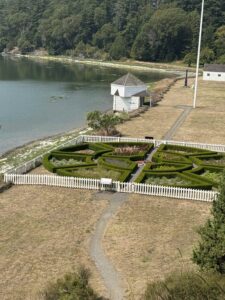
English Camp. Captain Delacombe’s garden.
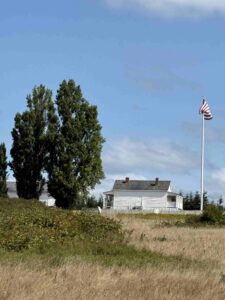
American Camp.
Leave a Reply