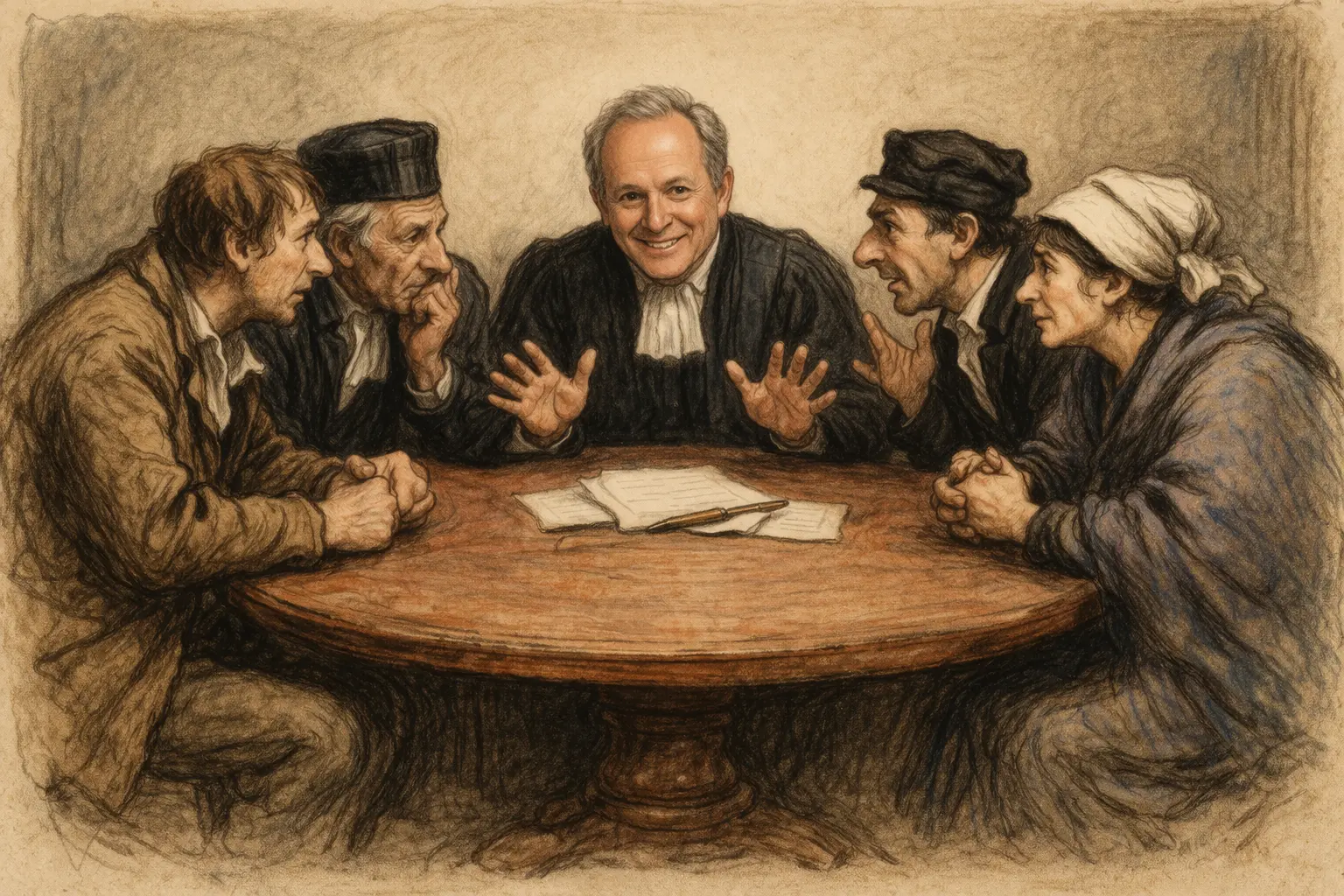
Nonsignatories, Agents: Absence Of Ostensible Or Actual Authority Means Arbitration Agreement Is Unenforceabler
Keep In Mind That Authority Must Be Created By The Principal, Not The Agent.
Kinder v. Capistrano Beach Care Center, LLC, B316937 (2/7 5/18/13) (Escalante, Perluss, Feuer) is a lawsuit brought by a resident of a residential skilled nursing facility who broke her hip in a fall and sued. The nursing facility tried, unsuccessfully, to enforce an arbitration agreement, and was no more successful in the Court of Appeal.
The problem is that Nancy Kinder, who broke her hip, did not sign the arbitration agreement. Her children did, but there was a lack of proof that they had actual or ostensible authority to sign.
COMMENT: There are many lawsuits brought by aged residents of nursing homes in which the defendant seeks to enforce the arbitration agreement. Sometimes, as here, the injured person is a nonsignatory to the agreement. When that is the case, it may not be possible to enforce the agreement. The arbitration agreement might have been enforceable if the resident had signed and had capacity, if there had been an effective power of attorney, or if the signatory had acted under a conservatorship. Perhaps the difficulty of obtaining a power of attorney or a conservatorship is the simple explanation for why this is not done. And if the resident lacks capacity at the time the power of attorney is entered into, that's yet another problem.
Employment: Employee’s Release Of Claim After It Accrued Is Not Illegal Or A Violation Of Public Policy
Employee Entered Into Release Of Claims In Her Separation Agreement.
Elizabeth Castelo entered into a release of claims in her separation agreement from her employer Xceed Financial Credit Union. In arbitration, the employee argued that she had entered into a pre-dispute arbitration agreement that was invalid. The arbitrator ruled in favor of the employer, the court confirmed the award, and the employee appealed. Castelo v. Xceed Financial Credit Union, B311573 (2/7 5/18/23) (Escalante, Perluss, Segal).
Some pre-dispute releases can be found invalid under some circumstances. Civil Code section 1668 provides: "All contracts which have for their object, directly or indirectly, to exempt any one from responsibility for his own fraud, or willful injury to the person or property of another, or violation of law, whether willful or negligent, are against the policy of the law."
Here, however, the Court of Appeal agreed that Castelo knew about her claims before she entered into the release of claims. There was no violation of public policy.
Construction Of Agreement And Unconscionability: Confidentiality Agreement And Arbitration Clause Were Construed Together
File This Under "More Ways Than One To Skin A Cat."

Woman wearing a blue robe with Buzzer the cat. Photographer: Arnold Genthe. Library of Congress.
Alberto v. Cambrian Homecare, B14192 (2/4 filed 4/19/23, cert for pub. 5/10/23) (Daum, Collins, Currey), affirms the trial court's order finding an arbitration clause unconscionable.
Here's the wrinkle. Ordinarily, a contract and an arbitration provision are separately construed, and the court must decide whether the arbitration provision is unconscionable. Here, there was a confidentiality agreement, and a separate agreement to arbitrate. Or were they separate? Neither agreement incorporated by reference the other agreement.
But as we said above, there's more than one way to skin a cat. Here, the court construed the two agreements together, applying Civil Code §1642. That section provides: "Several contracts relating to the same matters, between the same parties, and made as parts of substantially one transaction, are to be taken together."
The confidentiality agreement allowed the employer to obtain immediate injunctive relief for a breach of confidentiality and apparently was not symmetrical. The discussion of wages among employees was prohibited. In contravention of PAGA, the arbitration agreement created a blanket prohibition of representative actions, absent mutual consent. The agreements, construed together, infected one another.
Happy July 4th To All My Readers !
On The Occasion Of Our 247th Fourth Of July . . .
Photo credit to Amy Widdowson, publisher of The Morning Missive https://substack.com/@amy
Stays: Supreme Court Overrules 9th Circuit And Orders Trial Court Proceedings Must Be Stayed Pending Appeal Over Arbitrability
The Supreme Court Created A New Rule For Staying Cases Pending Interlocutory Appeal Of Order Denying Motion To Compel Arbitration.
Prof. Ronald Mann provides an excellent review in ScotusBlog of the Supreme Court's decision in Coinbase v. Bielski, No. 22-105 (S.Ct. 6/23/23). The majority opinion, authored by Justice Brett Kavanaugh, holds that a district court must stay its proceedings while an interlocutory appeal on the question of arbitrability is ongoing.
In federal court, the general rule is that an interlocutory review of a trial court order leaves the rest of the case intact in the trial court. However, a party that wants to stay the case pending the review can seek a particularized determination from the trial court as to whether its proceedings should be stayed. As the dissent summarizes in Coinbase, the determination will hinge on consideration of "likelihood of success on the merits, irreparable harm, favorable balance of equities, and alignment with the public interest."
However, in Coinbase, the Supreme Court considered whether there should be a blanket stay rule, rather than a particularized determination, in the context of 9 USC § 16(a). This section of the Federal Arbitration Act allows a party to immediately appeal from an order denying a petition to order arbitration.
Justice Kavanaugh acknowledged that § 16 does not state whether proceedings should be stayed pending appeal. However, he believed a stay would prevent a detrimental result if the matter could be entirely litigated without a stay, only to find out that it should have been arbitrated.
COMMENTS. Justice Ketanji Brown Jackson dissented, joined by Justices Elena Kagan and Sonia Sotomayor and mostly by Justice Clarence Thomas. Aside from the legal arguments, it is pretty easy to understand why the liberal justices dissented. The majority created a bespoke rule for defendants who oppose arbitration — in this case, for a cryptocurrency company seeking to avoid class action litigation. This ability to stay is not symmetrical, because under § 16(b), an interlocutory appeal may not be taken from an order requiring arbitration. Therefore, employees and consumers bringing class action litigation will not be able to appeal from orders requiring them to arbitrate, and thus will not be able to stay arbitration. Why Justice Thomas joined with his liberal brethren is less easy to explain. Perhaps he agreed with their reasoning?
Ronald Mann notes that this case concerning arbitration may have much broader impact, if its ruling is extended to other federal cases where interlocutory appeals are available. If there is an across-the-board rule that in such cases, there should be a stay to prevent further proceedings below, then the rule requiring particularized examination of the justification for a stay will no longer apply.
We note that the result in Coinbase v. Bielski is likely the same result that would have occurred if the case had been brought in California state court (we only say "likely", because California state courts are more likely to push back against mandatory arbitration). In California, an order denying a motion to compel arbitration is appealable, and the appeal will stay proceedings below. But an order granting a motion to compel arbitration is not appealable. In some circumstances, it may be challenged by writ. Zembesch v. Superior Court, 146 Cal.App.4th 153 (2006).
Mediation Confidentiality: California Mediation Confidentiality Survives New Rule Requiring Reporting Of Professional Misconduct
California Supreme Court Approves New Rule of Professional Conduct On June 2, 2023.
The California Supreme Court approved a much discussed Rule of Professional Conduct requiring lawyers, without undue delay, to report professional misconduct.
Much as lawyer misconduct in the Watergate Scandal resulted in professional ethics requirements and testing in California, the Girardi Affair has triggered a response from the State Bar and the California Supreme Court requiring the reporting of professional misconduct. Fortunately for mediators, the new rule does not override mediation confidentiality.
Part (d) of the Rule, which is linked here, states: "This rule does not require or authorize disclosure of information gained by a lawyer while participating in a substance use or mental health program, or require disclosure of information protected by Business and Professions Code section 6068, subdivision (e) and rules 1.6 and 1.8.2; mediation confidentiality; the lawyer-client privilege; other applicable privileges; or by other rules or laws, including information that is confidential under Business and Professions Code section 6234."
BONUS: From Wikipedia: "An informant (also called an informer or, as a slang term, a "snitch", "rat", "stool pigeon", "stoolie" or "grass", among other terms) is a person who provides privileged information, or (usually damaging) information intended to be intimate, concealed, or secret, about a person or organization to an agency, often a government or law enforcement agency."
""