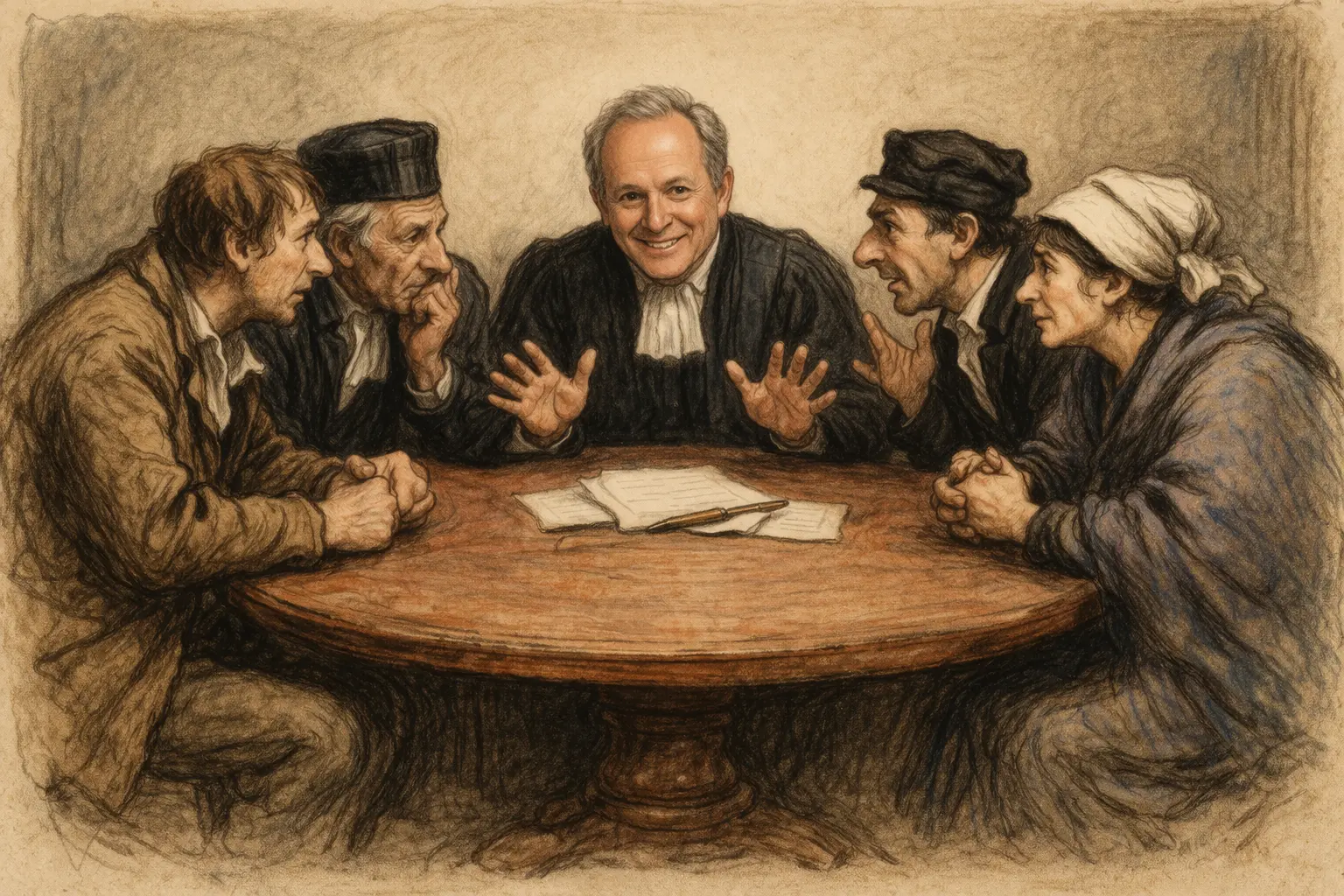
Non-Signatories’ Efforts To Compel Arbitration Based On Equitable Estoppel, Agency, and Third-Party Bene Theories All Failed
The Trial Judge Said He Had An Issue Of First Impression.
Jessica Hernandez sued Meridian Management Services, LLC and other entities for employment violations. The defendants sought to piggyback on to an arbitration agreement that Ms. Hernandez had entered into with her employer Intelex in order to compel her to arbitrate. Her lawyer, however, was careful with the pleadings, for Hernandez apparently did not name Intelex as a party, nor did she claim that Intelex and her other employers, the defendants (Other Firms) were joint employers. The trial judge denied the motion of the Other Firms to compel arbitration based on a contract with an arbitration agreement they had not signed. And the Court of Appeal held that the trial judge was right. Hernandez v. Meridian Management Services, LLC, B312814 (2/8 1/30/23) (Wiley, Stratton, Grimes).
It was not as if there was no relationship between Intelex and the Other Firms. After all, Ms. Hernandez worked for both. Moreover, though the Other Firms were separate legal entities from Intelex, they were "functionally related." Hernandez "alleged the Other Firms shared the same legal and physical address; the same human resources person; the same controller; the same payroll department; the same risk management and legal services; and the same centralized information technology." But whatever the functional relationships, they were not enough for defendants to compel arbitration based on theories of equitable estoppel, agency, or third party beneficiary.
Equitable estoppel. This is the issue that led the trial judge to state he had an issue of first impression on his hands: “[t]ypically the doctrine of equitable estoppel is applied where a signatory has sued both another signatory and certain non-signatories on identical claims. . . . [¶] But what happens if the other party to the contract is not also a party to the case, and never was?" Intelex, the party with the arbitration agreement in its contract, was not a party to the case, yet it was the Intelex agreement that the Other Firms wished to take advantage of. In any case, the Court of Appeal concluded that equitable estoppel could not apply because there was no evidence Hernandez was trying to take advantage of anything she had done wrong.
Agency. The Other Firms offered no evidence that they were empowered to act on behalf of Intelex.
Third-party beneficiary. There was no evidence that it was a motivating purpose of Intelex and Hernandez to provide a benefit for a third party.
Affirmed.
Deadlines: Deadlines To Vacate Or Correct Arbitration Award Are Strictly Applied By Second District, Div. 2
Darby v. Sisyphian, LLC, B314968 (2/2 1/26/23) (Hoffstadt, Ashmann-Gerst, Chavez), Helpfully Lays Out Deadlines To Confirm, Vacate, Or Correct Award.
#/media/File:Punishment_sisyph.jpg "image from en.wikipedia.org")
Sisyphus. Titian. Public Domain. Wikipedia.
Aisha Darby, an exotic dancer, arbitrated wage and hour claims with her employer Sisyphian, LLC. After robust advocacy in arbitration, she eventually received an award of $105,109.75 — less than she and her attorney sought, more than the respondent thought they were entitled to. She petitioned to confirm the award. Respondent had a 10 day window to respond and seek to vacate or correct the award, but waited 32 days. Respondent's untimely response meant the award was successfully confirmed. The Court of Appeal further held that Sisyphian's failure to timely respond to vacate or correct in the trial court deprived the Court of Appeal of the ability to consider arguments to vacate or correct.
BONUS:
The Court of Appeal summarizes key deadlines:
— Four years to petition to confirm an award from the date the award is served. Cal. Code of Civ. Proc. § 1288.
— The shorter of: (1) 100 day rule. A petition to vacate an award or to correct an award shall be served and filed not later than 100 days after the date of the service of a signed copy of the award on the petitioner. 1288; (2) 10 day rule. A response to vacate or correct an award shall be served and filed within 10 days after service of the petition to confirm. 1290.6.
— The 100 day rule is jurisdictional. The 10 day rule is jurisdictional, but it can be extended by agreement of the parties, or by the court for good cause if no one will be prejudiced.
COMMENT: The economics of this case are hard to fathom. While it may seem at first blush that the employer got socked with a $105,109.75 award — not chump change — that's not the whole story. Darby's award included $82,800 in attorney's fees and $23,347.25 in compensation, minus $1,037.50 in costs for which she was responsible. She had requested $283,941.25 in attorney's fees. So she prevailed, but someone took a haircut.
Mike Hensley's and my blog, California Attorney's Fees, makes the point that sometimes attorney's fees are the tail that wags the dog. Darby v. Sisyphian, LLC is such a case. Readers can also find a post about this case on our attorney's fees blog.
Existence Of Agreement, Unconscionability: First District, Div. 4 Concludes Arbitration Agreement Was Signed, Not Unconscionable, And Reverses
Proof Of Handwritten Signature May Be Easier Than Proof Of Electronic Signature.
The trial court found that the employer failed to prove employees had signed an arbitration agreement, that the agreement was unconscionable, and the court rejected the employer's efforts to compel arbitration. The Court of Appeal reversed. Leroye Iyere et al. v. Wise Auto Group, A163967 (1/4 1/19/23) (Pollak, Brown, Goldman).
In the trial court, the employees provided declarations that they had been given many documents to hurriedly sign, that they had not read them, and that if they had read them, they would not have signed them, knowing that they were giving up rights by agreeing to arbitrate. But they did not squarely deny that handwritten signatures of their names were their signatures. While the trial court refused under those circumstances to find that the employees had signed, Justice Pollak explained: "It is hornbook law that failing to read an agreement before signing it does not prevent formation of a contract."
The panel disagrees with Gamboa v. Northeast Community Clinic, 72 Cal.App.5th 158. (2021), which cited cases rejecting proof of electronic signatures under similar circumstances in order to reject proof of a handwritten signature. Justice Pollak explains: "Authenticating an electronic signature if challenged can be quite daunting. . . If a party confronted with his or her handwritten signature on an arbitration agreement is unable to allege that the signature is inauthentic or forged, the fact that that person does not recall signing the agreement neither creates a factual dispute as to the signature’s authenticity nor affords an independent basis to find that a contract was not formed."
The employees argued that the arbitration provision, which was governed by the Federal Arbitration Act, was unconscionable, because California Labor Code § 925 provides that an employer cannot require an employee who resides and works in California, as a condition of employment, to agree to adjudicate a claim arising in California outside of California. But the FAA does not displace state substantive law, which can be asserted in arbitration, so this argument failed.
The employees also argued that the contract, which allowed the party against whom a claim was made to choose between two arbitration providers, and that this would benefit the employer as the party against whom a claim was more likely to be made. But the panel believed this would not provide a significant advantage to the employer, as both dispute resolution providers were well recognized and respected dispute resolution providers.
Existence Of Arbitration Agreement: Arbitration Agreement For Website Did Not Apply To In-Store Purchases
Existence Versus Scope Of Arbitration Agreement — See How It Makes A Difference.
Tire recapping. A service attendant points out a worn tire that may be recapped under a new plan which removes restrictions on reclaimed camelback rubber for passenger tires. The plan to recap passenger car tires with reclaimed rubber camelback, approved by rubber director William M. Jeffers, was put into effect in February 1943 to reduce the demand for replacement tires and still keep civilian cars in service. Library of Congress. Alfred T. Palmer, photographer. February, 1943.
A label can make a difference. Doubts concerning the scope of an arbitration agreement are generally resolved in favor of arbitration. That's the presumption in favor of arbitration at work. But that presumption does not apply when there are doubts as to the existence of an arbitration agreement. The panel deciding Kevin Johnson v. Walmart, Inc., 21-16423 (9th Cir. 1/10/23) (Sessions, Tashima, Paez), agreed that the issue concerned the existence of an arbitration agreement, rather than its scope, making their decision a bit easier, since application of the label "existence" rather than "scope" meant the panel did not have to deal with a presumption in favor of arbitration.
Kevin Johnson used a Walmart website that included an arbitration agreement to purchase tires. When he went to the store to have the tires installed, he purchased a lifetime tire balancing and rotation agreement. The in-store purchase did not come with an arbitration agreement. At some point, Walmart allegedly stopped balancing and rotating tires for Johnson, so he sued on behalf of a putative class. Despite broad language in the arbitration agreement that “. . . all disputes arising out of or related to these Terms of Use or any aspect of the relationship between you and Walmart . . . will be resolved through final and binding arbitration", the court held that the arbitration agreement did not apply to the in-store purchase.
Language introducing the arbitration provision stated: “These Terms of Use govern your access to and use of all Walmart Sites.” The court interpreted this to mean that the arbitration agreement did not apply to the in-store purchase. And since the opinion explained this was a question of the existence rather than the scope of an agreement, it did not need to deal with a presumption in favor of arbitrability.
So: two separate contracts, one with an arbitration agreement, one without, both contracts involving tires, both contracts involving the same parties, but one contract applying to Walmart [online] sites, and the other contract applying to in-store purchases. Conclusion: no arbitration agreement existed for the in-store purchase.
Waiver: Fourth District Div. 2 Holds Lengthy Delay And Failure To Timely Take Affirmative Steps To Arbitrate Results In Waiver Of Right To Arbitrate
Thirty-Nine Page Slip Opinion Hinges On Issue Of Waiver.
The Court of Appeal addresses a variety of issues in the context of a complicated procedural history in Desert Regional Medical Center v. Leah Miller and Desert Regional Medical Center v. Lynn Fontana, E076058 and E076069 (4/2 1/6/23) (Codrington, Ramirez, Raphael).
The procedural history was complicated by the overlapping pendency of a collective bargaining grievance procedure and the lawsuits brought by individual employees, who were employees at the Desert Regional Medical Center (DRMC). Did the individual actions need to be stayed while the union procedure was exhausted? Did the arbitrability of these cases need to be decided by the court or the arbitrator? Did the Federal Arbitration Act or the California Arbitration Act apply? Did the Labor Commissioner have jurisdiction to hear claims brought by the employees, or did the claims need to be arbitrated? Were the employees estopped from arguing that the employer waived the right to arbitrate? Was prejudice necessary to find a waiver of the right to arbitrate? Interesting questions, but in the end the outcome hinged on whether the employer waived the right to arbitrate.
In the end, the Court of Appeal affirmed the trial court's order denying a motion to arbitrate, agreeing that the employer waived its right to arbitrate. There was an issue as to how long the employer had delayed bringing a motion to arbitrate. That delay was at least a year, possibly up to four years. The court concluded that even during a one year delay, the employer acted inconsistently with asserting a right to arbitrate by engaging in further litigation procedure.
Scope Of Arbitration Agreement Did Not Encompass Pre-Employment Disputes
Court of Appeal Also Held That Trial Court Properly Declined To Require Arbitration Of FEHA Claim For "Public Injunction."
Defendant and Appellant Tesla, Inc. — you've probably heard of the company — appealed from denial of Tesla's motion to compel arbitration as to employees Chatman and Hall, plaintiffs. Marcus Vaughn et al v. Tesla, Inc., A164053 (1/5 1/4/23) (Simons, Burns, Wiseman). Plaintiffs alleged that they and other Black employees had been discriminated and harassed while working at Tesla.
The wrinkle to this case is that, while an arbitration agreement provided all "disputes, claims, or causes of action, in law or equity, arising from or relating to your employment, or the termination of your employment, will be resolved, to the fullest extent permitted by law by final, binding and confidential arbitration . . . ", the agreement did not cover pre-employment claims. And Chatman and Hall claimed some claims arose pre-employment, at a time when a hiring agency had provided them as workers to Tesla. So the trial court concluded that Chatman and Hall were required to arbitrate claims after they became employees, but not before.
The Court of Appeal affirmed the order denying arbitration in part and allowing arbitration in part. The Court also agreed that the trial court properly declined to mandate arbitration of plaintiffs' claim for a public injunction for two reasons: "First, we hold that injunctions sought under the Fair Employment Housing Act (FEHA) (Gov. Code, §§ 12900 et seq.) may be considered 'public injunctions.' Second, we rule the Federal Arbitration Act (FAA) (9 U.S.C. § 1 et seq.), as interpreted in Viking River Cruises, Inc. v. Moriana (2022) ___ U.S. ___ [142 S.Ct. 1906, 213 L.Ed.2d 179] (Viking River), does not preempt the California rule prohibiting waiver of the right to seek such injunctions."