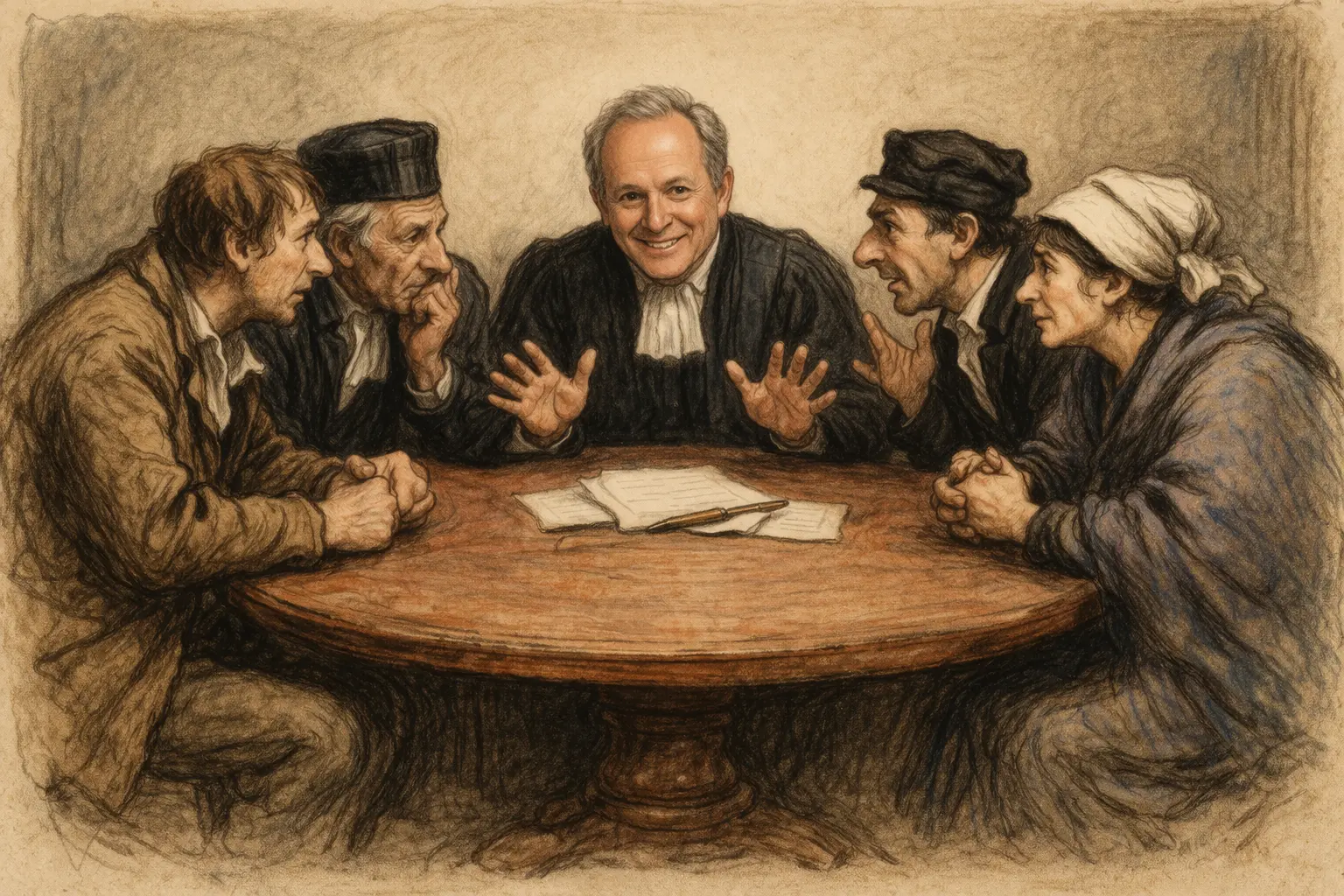
Reviews: Our Blogger’s Review Of New Book About Gov. Jerry Brown Is Republished Here
The Book Is Journalist Jim Newton's Man of Tomorrow: The Relentless Life of Jerry Brown.
For those of you who enjoy reading about California politics and politicians, I've written a review of Jim Newton's new book about former Governor Jerry Brown. The review, which appears in California Litigation, Vol. 34, No. 1 (2021), is republished here with the permission of the California Lawyers Association and its publication, California Litigation. The review is republished with the disclaimer that I alone am responsible for any opinions expressed therein.
Mediation, Attendance, And Settlement: Parties Failing To Attend Probate Court-Ordered Mediation Could Not Complain About Settlement Reached By Participating Parties And Judge Changes His Mind
Justice Tangeman, Who Concurred Before, Now Dissents After Rehearing.
We posted on February 2, 2021 about Breslin v. Breslin, B301382 (2/6 1/26/21) (Gilbert, Yegan, Tangeman), an opinion authored by Justice Gilbert in which Justices Yegan and Tangeman concurred. The case held the party receiving notice of a mediation ordered by the probate court and failing to participate in court-ordered mediation is bound by the result.
Justice Tangeman, who concurred, has now dissented, having changed his position after a rehearing.
Justice Tangeman explains his position: "A charitable gift must be carried into effect if it 'can possibly be made good.' (Estate of Tarrant (1951) 38 Cal.2d 42, 46.) The majority’s newfound requirement that a party participate in mediation before it can inherit ignores this command. It will reduce the number of gifts that 'can possibly be made good' by encouraging parties to send out mediation notices whenever they desire to eliminate gifts to beneficiaries that don’t appear—for whatever reason."
Arbitration, Jurisdiction, Discovery: Ninth Circuit Determines How Amount Requirement In Diversity Jurisdiction Applies To Subpoenas Issued By Arbitrators
The Majority Looks At The Amount-In-Controversy In The Underlying Dispute, And The Concurring Opinions Looks At The Amount Involved In The Discovery Dispute.
The panel in Maine Community Health Options v. Albertsons Companies, Inc., No. 20-35931 (9th Cir. 3/31/21) (Hurwitz, Fletcher; Watford concurring) determines how "the amount-in-controversy requirement in 28 U.S.C. § 1332(a) is satisfied in an action under Section 7 of the Federal Arbitration Act ("FAA"), 9 U.S.C. § 7, seeking enforcement of a third-party subpoena issued by arbitrators." Let's unpack that question.
Section 7 of the FAA authorizes district courts to enforce third-party arbitration subpoenas. However, merely invoking the FAA to enforce discovery does not create federal jurisdiction — one still needs an independent basis for federal jurisdiction. One basis for federal jurisdiction is diversity jurisdiction where the parties are citizens of different states and the amount-in-controversy exceeds $75,000. 28 U.S.C. § 1332(a).
How does one apply these seemingly simple rules to a third-party subpoena issued by arbitrators to obtain requested documents, when the company requesting documents and the company producing documents are citizens of different states? Does one look at the amount at stake in the discovery request, or the amount at stake in the underlying arbitration that generated the third-party subpoena? And does one focus on the benefit to the plaintiff or the detriment to the defendant in a discovery dispute in order to determine amount-in-controversy?
In Maine Community Health Options, an overbilling dispute concerning Maine Community and Navritus Health Solutions, LLC, a pharmacy benefits manager, over Navritus's billings, the underlying dispute between those two companies involved potentially $17 million, clearly far above the amount-in-controversy requirement for diversity jurisdiction. But that's not how the majority opinion analyzed the issue. Instead, the majority focused on the amount involved in the discovery dispute between Maine Community, and Albertsons, which was the third party subpoenaed to produce the documents. In a way, that makes sense, because Maine Community filed its action in federal court to enforce the subpoena against Albertsons, invoking § 7, but the underlying dispute was between Maine Community and Navritus, and that dispute was in arbitration. Hence, the parties to the federal action are only Maine Community and the third party it subpoenaed. And typically, one would look at a complaint in federal court rather than a claim in arbitration to determine amount-in-controversy.
Writing for the majority, Judge Hurwitz explains "we agree with the Second Circuit that the amount-in -controversy in a Section 7 enforcement action can be measured by either the benefit to the plaintiff or the detriment to the defendant that would result from enforcement of the subpoena." In this case, Abertsons claimed the cost to it of production was $1,400, i.e., far below the jurisdictional amount-in-controversy requirement. But in this case, Maine Community provided a good faith allegation that the value of the subpoenaed information to it exceeded $75,000, and Albertsons failed to show "to a legal certainty" that the claim was less than the jurisdictional amount.
Concurring, Judge Watford reached the same outcome by a very different route. He would have looked at the amount-in controversy in the underlying arbitration — $17 million. If the court could have had diversity jurisdiction in the original dispute, then it could have approved third party subpoenas against third parties. So Judge Watford would ask whether the court would have jurisdiction over the underlying dispute. And if it wouldn't have had jurisdiction, then the subpoena wouldn't issue.
COMMENT: Under the majority opinion, one needs here to look at the amount-in-controversy in the action filed in federal court between the parties to the discovery. Under the concurring opinion, one needs to look at the amount-in-controversy in the underlying arbitration. Is it really easier to do one rather than the other?
International Arbitration, Discovery: SCOTUS Grants Review In Servotronics, Inc. v. Rolls-Royce PLC
Can US Federal Courts Allow Discovery For Private International Arbitrations?
As set forth in SCOTUSBlog, this is the issue before the Supreme Court in Servotronics, Inc. v. Rolls-Royce PLC: "Whether the discretion granted to district courts in 28 U.S.C. § 1782(a) to render assistance in gathering evidence for use in 'a foreign or international tribunal' encompasses private commercial arbitral tribunals, as the U.S. Courts of Appeals for the 4th and 6th Circuits have held, or excludes such tribunals without expressing an exclusionary intent, as the U.S. Courts of Appeals for the 2nd, 5th and, in the case below, the 7th Circuit, have held."
The key issue is whether private international arbitration qualifies as "a foreign or international tribunal", in which case discovery could be permitted in U.S. district courts.
John Elwood, posting on March 18, 2021 for SCOTUSBlog, writes: "Servotronics notes that until the provision was revised in 1964, it applied to 'any judicial proceeding pending in any court in a foreign country.' Servotronics contends that the change in wording suggests Congress intended to include quasi-judicial proceedings such as arbitral proceedings. We’ll have a better idea what the Supreme Court thinks on Monday." That was written before the Supreme Court granted cert on March 22, 2021.
On March 22, 2021, Paul Weiss Rifkind Wharton & Garrison LLP posted about Servotronics on Lexology. The post makes the point that, regardless of how the case is decided, issues are likely to remain regarding the interpretation of 1782: "First, even after the Supreme Court rules in Servotronics, we may not know whether an international arbitration seated in the United States qualifies as a 'foreign or international tribunal' under Section 1782. In addition, regardless of the outcome, courts may continue to find that investor-state arbitrations qualify for Section 1782 discovery."
Arbitration, Vacatur, Illegality, Fees: Second District, Div. 8 Holds That Arbitrator Could Decide Contract Was Illegal
Who Decides Illegality Of A Contract, The Arbitrator Or The Court?
Michael Bacall, an actor, was represented by Jeffrey Shumway, an attorney, who provided "legal/management services and [Chief Content Officer] services." Bacall alleged Shumway failed to disclose he was "inactive" with the State Bar, and Bacall terminated the contract with Shumway and his company Timaeus. Timaeus filed a demand for arbitration with the AAA, and Bacall filed a complaint asserting various claims, including breach of contract and rescission. The trial court granted the motion to arbitrate (be careful what you ask for), and the arbitrator issued an award requiring Shumway and Timaeus to return $201,025.82 to plaintiffs/respondents Bacall and his company RBC Entertainment, and also to pay them $237.607.25 in fees and costs.
Shumway and Timaeus appealed. Michael Bacall et al. v Jeffrey Shumway et al., B302787 (2/8 3/16/21) (Ohta, Grimes, Wiley).
The chief argument by Shumway was that it was the duty of the court, not the arbitrator, to review the legality of the contract. This was somewhat curious, given that it was Bacall who filed a lawsuit and Shumway who successfully moved to compel arbitration. Shumway relied on a case, Loving & Evans v. Blick, 33 Cal.2d 603 (1949), in which a party sought to vacate an arbitration award on the basis the arbitrator enforced an illegal contract, and the California Supreme Court held the arbitrator who enforced an illegal contract exceeded his powers. Why? An arbitrator who enforces an illegal contract presumably has no rights and powers conferred under the contract. But the Loving case did not convince the court here, because the situation was the opposite: instead of enforcing an illegal contract, "the arbitrator severed the unlawful legal services rendered on a contract that Respondents had terminated . . . and allocated damages accordingly."

Russian-made antipersonnel mine in Cambodia. Creative Commons License.
Another aspect of the case concerning legal fees is troubling as an example of the landmines litigators can step on in arbitration. Shumway alleged the arbitrator engaged in misconduct by denying an opportunity to address issues related to attorney fees and costs. After the arbitration hearing, Bacall requested attorneys fees and costs and submitted billing records. Shumway's counsel wrote to the arbitrator that arbitrators typically entertain such requests after an award has been rendered. The arbitrator wrote back: "Consideration of attorney fees will not take place until the case is decided and a prevailing party is determined. Anything submitted in that regard will not be read until then." Shumway did not submit a response, and the arbitrator's final award also included the fee award.
Evidently Shumway felt sandbagged by the arbitrator's response. But the Court of Appeal disagreed, though it did acknowledge, "the arbitrator's response was vague," and that one might not know best how to argue the attorneys fees issue before one knew who would be the prevailing party However, the court pointed out that the arbitrator had not never explicitly ordered that Shumway could not file an opposition before the arbitrator addressed fees and costs.
COMMENT: Regarding the briefing of the fees and cost issue, the Court explained, "the onus was on Appellants to seek clarification, which they failed to do." Good advice — and a painful lesson.
Confidentiality, Videoconferencing: What Information Does Zoom Keep?
Do You Know What Information Zoom Has About Your Communications?
Mediators, arbitrators, litigators, and parties are rightly concerned about the confidentiality of communications. Mediators rely on the mediation confidentiality protections in the California Evidence Code, sections 1119 et seq, and litigators and arbitrators rely on confidentiality agreements. Today, many of us are using online videoconferencing platforms to communicate, and we also seek assurances that those platforms preserve confidentiality. The widespread use of Zoom led to concerns about how Zoom communications were encrypted, and also led to the use of passwords and waiting rooms to protect participants from unwanted intruders. And it is common at the beginning of Zoom conferences, if not earlier, to insist that participants agree that they will not take screen snapshots, or record Zoom video or chat.
But what information does Zoom preserve that might be reached by a government agency or a subpoena?
There are several online sources that are helpful in answering this question:
First and foremost, the Zoom Government Requests Guide is the place to go. The Guide discusses types of data Zoom has, data retention practices, preservation requests, U.S. and international government requests for user information, notification to users of requests for user or meeting information, details that must be included in information requests, production of documents, user consent, emergency requests, and expert witness testimony and authentication of records.
Zoom provides the following high-level summary of types of data it has: "We obtain data that users provide to us, as well as data that our system collects. We may also obtain some data from visitors to our marketing websites. . . .We have not built a mechanism to decrypt live meetings for any purpose, including lawful intercept, and we do not have the means to insert our employees or others into meetings without that person being visible as a participant. As such, we do not collect or maintain information related to meeting content unless requested by the meeting host, for example, to record and store the meeting in our cloud. Zoom does not sell user data and we have no intention of selling user data going forward."
Zoom's information about data it has should be read together with its Privacy Statement.
Our takeaway is that metadata may be kept by Zoom, as well as video, audio, and chat recording that the user decides to store in the cloud. The limitations to accessing such information are set forth in greater detail in the Guide.
Second, in addition to the policies described on the Zoom website, take a look at the Stored Communications Act, 18 U.S.C. sections 2701-2712. This is a law that addresses voluntary and compelled disclosure of "stored wire and electronic communications and transactional records" held by third-party internet service providers.
Third, here are some articles still available online, at the time of this post, that are relevant to understanding the accessibility of Zoom's data:
- Dan Zelenko, Nimi Aviad, John Davis, Rukiya Mohamed and Bridget Carr, Anticipate Gov't Subpoenas of Your Zoom Recordings, April 23, 2020, Law360
- Suhauna Hussain, Is Zoom safe to use? Here's what you need to know, April 13, 2020, Los Angeles Times
- Nico Grant and Candy Cheng, Zoom Says Subpoena Is Needed to Work with Law Enforcement, June 5, 2020, Los Angeles Times