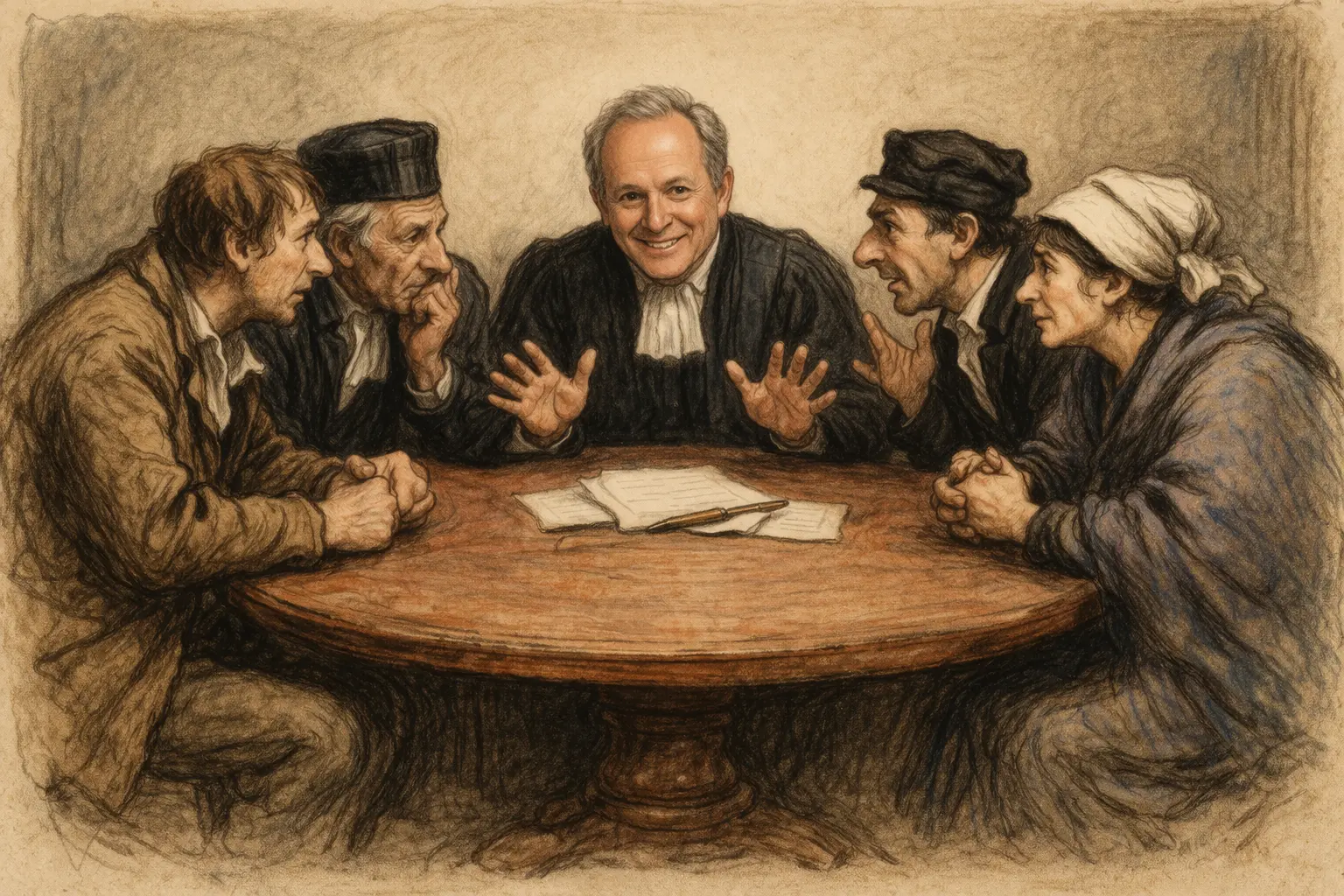
Arbitration, Disclosures: Arbitrator’s Nondisclosure Of Involvement With LGBTQ Organization Not A Basis For Tossing Arbitration Award
The Arbitrator's Relationship With GLAAD Was Irrelevant To The Dispute.
The arbitration award was confirmed and affirmed on appeal in Malek Media Group LLC v. AXQG Corp., B299743 (12/16/20 )) (Dhanidina, Lavin, Egerton), a case in which the disgruntled appealing party sought to disqualify the arbitrator for failure to disclose his connection with GLAAD, the Gay & Lesbian Alliance Against Defamation. The appellant made the tenuous argument that the arbitrator's involvement with LGBTQ rights had to be disclosed, because a witness had accused Malek of sexual harassment, LGBTQ rights activists were feminists who assumed the woman was telling the truth, and finally, Malek was Catholic, and the Catholic Church was at odds with same-sex marriage.
The Court of Appeal dispatched with the non-disclosure argument, finding an affinity with LGBTQ issues to be irrelevant to the subject matter of the case. "MMG mischaracterizes the arbitration as one that primarily involved issues of sexual harassment or social justice, " explained the Court. "The arbitration involved the dissolution of Foxtail [the LLC formed by the parties] based on the irreconcilable conflict between Malek and Gou and the numerous breaches by Malek of the Foxtail agreement, primarily, Malek’s misuse of Foxtail funds." The person claiming sexual harassment was not even a party to the case, and her testimony was only relevant to the case to the extent that it tended to show that Malek's actions subjected the LLC formed by the parties to reputational harm. Finally, the sexual harassment/reputational issue only yielded a measly $500 as part of the arbitrator's award.
The Court also found the appeal to be frivolous, resulting in sanctions. A post about the sanctions aspect of the case can be found on Mike Hensley's and my California Attorney's Fees Website.
COMMENT. We have previously posted about Rebmann v. Rohde, 196 Cal.App.4th 1283 (2011), which is dispositive in Malek Media Group LLC v. AXQG Corp. The earlier case involved a disgruntled party in arbitration and a Jewish arbitrator. In Rebmann: "The defendant/appellant informed the trial court that if only he had 'known about his [the arbitrator's] religious affiliation, his cultural affiliation, and the dedication to keeping the memory of the Holocaust alive, I never would have allowed him to be the arbitrator in my case.' The defendant/appellant's father, and his wife's father served in the SS during WWII. Among other things, the Court of Appeal rejected the 'tacit assumption' that 'a judge who is a member of a minority cannot be fair when a case somehow related to that minority status – no matter how remote or tenuous that relationship might be – comes before that judge.'"
Unhappy litigants have long complained that judges and arbitrators could not be fair to them because of their race, ethnicity, religion, nationality, and more recently, sexual orientation and gender identity. This was true during the period of the Civil Rights Movement, and even more recently, a federal judge was attacked as biased, based on the claim that he was "Mexican." These types of attacks are very unlikely to succeed in a court of law. However, we note a difference in emphasis between the Rebmann case and Malek Media Group LLC. Where Rebmann rejected the assumption that a judge or arbitrator who is a member of a minority cannot be fair when a case is somehow related to minority status, Malek Media Group LLC makes the point that the arbitrator's interest in LGBTQ issues was irrelevant to the subject matter of the case. Both points are valid, but the emphasis is different.
Arbitration, Delegation, Agents: Two Cases In Medical Settings Show California Courts Scrutinize Arbitration Agreements Entered Into For The Sick And The Aged
California courts continue to scrutinize cases in which hospitals and nursing homes seek to enforce arbitration provisions. The medical settings often involve patients who are old, quite sick (or both), hurried admission processes, and urgency. These cases remind me of a story my law school torts professor told, about taking his daughter, who had injured her arm, to emergency care. Presented with the paperwork, the law professor asked, "where do I sign?"
Oh What A Difference A Little Thereof Makes.
In Sandoval-Ryan v. Oleander Holdings LLC, et al., C089486 (3rd Dist. 12/7/20) (Hull, Murray. Duarte), the Court of Appeal affirms an order of the trial court, holding that defendants, a skilled nursing facility, claimed the issue of arbitrability had been delegated to the arbitrator rather than the court to decide, lacked merit.
Defendants did not question the trial court's ruling against them on their motion to compel arbitration, only that the decision had been made by the trial court, instead of an arbitrator. Defendants argued that clear and unmistakable language delegated threshold arbitrability issues to the arbitrator. Their argument foundered on two shoals.
First, the language of the arbitration agreement provided that claims "arising out of the provision of services by the Facility, the admission agreement, the validity, interpretation, construction, performance and enforcement thereof . . . " were to be submitted to the arbitrator. The court concluded that "thereof" referred to the admission agreement only. OK, I had to read the clause twice myself.
Second, even if, arguably, the clause could be interpreted to cover issues of arbitrability concerning the provision of services, the "clear and unmistakable language" burden had not been carried by defendants.
Shaky Custom, Habit, And Practice Testimony That Is Contradicted Fails To Establish Agreement To Arbitrate.
Maria Garcia v. KND Development 52, LLC, et al., B301929 (2/4 12/15/20) (Manella, Willhite, Collins) is another case in a medical setting where the trial and appeal courts refuse to enforce an arbitration provision. The underlying case involved a patient who was allegedly injured, becoming infected with bedsores, and later dying.
The hospital did not carry its burden of establishing a binding arbitration clause (a) because it relied on the custom and practice testimony of a supervisor who did not interact with the patient; (b) because it relied on the custom and practice testimony of a receptionist who lacked first-hand recollection; and (c) the custom and practice testimony was contradicted by relatives of the patient who testified from first-hand personal knowledge. As a result of the thin evidence, the hospital was unable to establish that the relative who signed the hospital documentation had acted as an agent of the patient and had been authorized by the patient to agree to arbitration.
Reviews: Sweet Taste Of Liberty: A True Story Of Slavery And Restitution In America
Your Blogger Has Reviewed Sweet Taste of Liberty, And Includes A Link To The Review Below.
Rice University historian W. Caleb McDaniel won the Pulitzer Prize in history for this remarkable story about Henrietta Wood, an enslaved person in Kentucky, who was freed in Ohio, kidnapped by a slave broker, re-enslaved, sold in Kentucky, and freed after the Civil War. After returning to Ohio, she sued for restitution in federal court.
Wood was illiterate and signed her name with an X, so it is a tremendous feat of scholarship that her story can be told at all.
The most recent issue of California Litigation, the journal of the litigation section of the California Lawyers Association, is devoted to the theme of racial justice. I am one of the editors of the journal, and my review of the book, which appears in the recent issue, can be read by clicking here.
Arbitration, Enforceability, Fees: Froggy Arbitration Clause Buried Among the Lily Pads Is Too Inconspicuous To Require Arbitration
Inconspicuous As A Frog In A Thicket Of Water Lilies . . .

"Too lazy to feed himself, Washington, D.C., Aug. 15. Just plumb too lazy to catch his food on the fly like regular frogs do, Popeye, giant frog from Louisiana in the U.S. Department of Commerce aquarium, has to be fed his meals from acting [sic] as nursemaid for the critter." Library of Congress. 1937.
The inimitable Justice Arthur Gilbert writes: "An arbitration clause in a contract is invalid because the clause is as inconspicuous as a frog in a thicket of water lilies. The prevailing party is entitled to attorney fees per Civil Code section 1717. Speaking of frogs, Frog Creek Partners, LLC v. Vance Brown, Inc. (2012) 206 Cal.App.4th 515 (Frog Creek) does not prohibit the award of attorney fees." Domestic Linen Supply Co., Inc., v. L J T Flowers, Inc., B292863, B294788 (2/6 12/4/20).
Justice Gilbert, agreeing with the trial judge, explains why the arbitration clause was inconspicuous. Among other things, the arbitration clause was not above the purchaser's signature, but on the back of the agreement. The backside was filled with small type. The arbitration clause, lacking heading, boldface, italics or capitalization, was "simply hidden in a thicket of fine print." The sales representative presenting the agreement was not trained to bring attention to the arbitration clause. And the sales rep was advised to have the purchaser read the personal guarantee while filling out the contract, thus diverting from the backside of the contract.
Comment: A reader might at first have thought that leading with a discussion of the inconspicuousness of the arbitration clause would take us to the issue of unconscionability. No need to go there. Evidently the arbitration clause was so inconspicuous that Justice Gilbert concluded: "There was simply no agreement to arbitrate."
Regarding the issue of fees, the opinion distinguishes between (1) Frog Creek, in which a case was pending, plaintiff's first petition to compel arbitration was defeated, a second petition succeeded, and defendant ultimately prevailed on the merits; and (2) the instant case, in which a petition to compel arbitration was filed, and the petition was defeated. In the first situation, the petition is defeated, and the lawsuit continues. However, in the instant case, the defeat of the petition terminated the action, leaving the defendant as the prevailing party. And where there is a contractual basis to recover attorney's fees and a prevailing party, the prevailing party can recover attorney's fees.
Further Comment: If a Jim Murray prize for turning a phrase and color commetary in legal opinions could be awarded to California Appellate Justices, I would nominate Justice Gilbert and Justice William Bedsworth.
![[Lily pond at a garden, with a small pavilion and bridge on the right, and sightseers walking in the background, in China]](https://cdn.loc.gov/service/pnp/ppss/00500/00544r.jpg)
Lily pond. Jean E. Norwood, photographer. 1979. Library of Congress.
![[Turkey at White House, Washington, D.C.]](https://cdn.loc.gov/service/pnp/hec/41800/41804r.jpg)
Settlement: How To Blow A Mandatory Settlement Conference
When Overzealous Advocacy Becomes Contempt.
The conventional wisdom that there should be no way to lose a settlement conference is tested in Kevin J. Moore v. Superior Court of Orange County, G058609 (4/3 11/16/20) (Goethals, Bedsworth, Thompson). The facts of the underlying case are of little importance, because it was the conduct of attorney Moore at a mandatory settlement conference in OCSC that was at issue:
"While representing a client at a mandatory settlement conference (MSC) before a temporary judge, petitioner Kevin Moore was rude and unprofessional. Among other things, Moore (1) persistently yelled at and interrupted other participants; (2) accused opposing counsel of lying while providing no evidence to support his accusation; (3) refused to engage in settlement discussions; and (4) effectively prevented the settlement officer from invoking the aid and authority of the supervising judge by asserting this would unlawfully divulge settlement information. To make matters worse, Moore later acknowledged that his contemptuous behavior was the result of a tactical decision he had made to act in such a manner in advance of the MSC. After a hearing, respondent court convicted Moore of four counts of civil contempt, imposed a $900 fine for each count ($3,600 total), and ordered the payment of attorney fees and costs to the opposing party. (See Code Civ. Proc., § 1209 et seq.)"
As Justice Goethals explains, Moore did not get whacked for zealous advocacy. Indeed, a "failure to yield" at a settlement conference does not amount to contempt. Rather, it was rude and obstreperous conduct that got Moore in trouble. Among other things, the Court was not pleased that Moore had called opposing counsel a liar without explanation, and that he had told opposing counsel, "you could be dead," and that he had apparently used his behavior as a tactic: "Moore’s petition for writ of review, which brings the matter to this court, clarified his state of mind at the outset of the MSC: 'At the MSC, [Moore] employed a tactic in representing his client that included raising his voice and accusing [opposing counsel] of making false statements, which [Moore] believed to be true.' (Italics added.)"
In the Court of Appeal, attorney Moore succeeded in eliminating three of the charges, and reducing the fine to $900. Each party had to bear its own fees and costs. The Court consolidated and reduced the four counts into "a single count for Moore’s bad faith participation and obstreperous misconduct at the settlement conference." Perhaps this is a bittersweet victory, for Justice Goethals concludes, "Though Moore’s petition is largely successful, that success should in no way be construed as an endorsement by this court of his behavior." And the clerk of the court is directed to provide a copy of the opinion to the State Bar.
The opinion is well worth reading, because among other things, it describes the steps that must be taken to successfully issue a contempt order, and what was done correctly and incorrectly below.
COMMENT: Note that the conduct that was found to be contemptuous was in front of a temporary judge. Temporary judges in Orange County typically hold the MSCs outside the courtroom, often in the third floor cafeteria. Today, the MSCs are being held remotely via Zoom and other platforms. (And perhaps social distancing may actually be leading to more civil behavior). Therefore, the temporary judge often does not have easy access to a reporter and to a courtroom, where the TJ could make a record of direct contempt and summarily issue a contempt order. Instead, Moore was a case of "indirect contempt" that did not occur in the courtroom. "Although the settlement officer was acting as a temporary judge at the settlement conference," explains Justice Goethals, "he did not pursue summary contempt proceedings (we express no opinion on whether he should or could have done so)." Nevertheless, the case does show that when proper contempt procedures are followed, a temporary judge and the judicial process can be protected from contumacious behavior with an "indirect contempt" proceeding.