Internet Commerce: Ninth Circuit Holds A Mobile App Failed To Provide Constructive Notice Of Arbitration Agreement
An Issue Of First Impression — Did A Smartphone App Impart Constructive Knowledge Of An Arbitration Agreement?
The Ninth Circuit has decided an issue of first impression for the court: "[U]nder what circumstances does the download or use of a mobile application ('app') by a smartphone user establish constructive notice of the app's terms and conditions?" Not under the circumstances here, holds the court in Wilson v. Huuuge, Inc., No. 18-36017 (9th Cir. 12/20/19) (McKeown, Bybee, Gaitan)..
What were those circumstances? Plaintiff Wilson brought a class action alleging Huuuge Casino, which allows online gambling with a smartphone app, had violated Washington law by charging users for chips in its app. Huuuge moved to compel arbitration. The district court denied the motion, and the Court of Appeal affirmed: "Because Huuge did not provide reasonable notice of its Terms of Use . . . Wilson did not unambiguously manifest assent to the terms and conditions or the imbedded arbitration provision."
Huuuge failed to establish actual knowledge of the terms and conditions, so the issue hinged on whether there was constructive knowledge. Unlike a "clickwrap agreement", requiring users to affirmatively assent to terms of use before accessing a website for its services, the agreement here at issue was a "browsewrap", not requiring "the user to take any affirmative action to assent to the website terms." And the hoops through which the user would have had to jump to obtain notice meant that a reasonably prudent user would not be "on constructive notice of the terms of the contract for a browsewrap agreement to be valid." If a picture is worth a thousand words, then the opinion is helpful, because it provides shots of the five screens a user would have had to follow through and read to find the arbitration agreement.
Judge McKeown colorfully writes, "the user would need Sherlock Holmes's instincts to discover the terms."
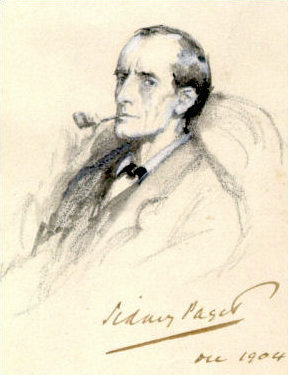
Sherlock Holmes Portrait By Sidney Paget. 1904. Wikipedia.
Judge McKeown adds: "When downloading the app, the Terms are not just submerged– they are buried twenty thousand leagues under the sea." The user is urged to read the Terms, but there isn't a link to the Terms: "This is the equivalent to admonishing a child to 'please eat your peas' only to then hide the peas. . . . Only curiosity or dumb luck might bring a user to discover the terms."
As the Judge sardonically concludes, "Huuuge chose to gamble on whether its users would have notice of its Terms" — a gamble the online casino lost.
Arbitration, Employment, Burden of Proof, Nonsignatories: Fourth District, Div. 1 Rules Employer Failed To Prove Employee Electronically Signed Arbitration Agreement
Authentication Of Electronic Signatures Continues To Generate Case Law And Stymie Employers.
We have blogged before about the problems employers have had authenticating employees' electronic signatures on arbitration agreement. On January 4, 2015, we blogged about Ruiz v. Moss Bros. Auto Group, Inc., 232 Cal.App.4th 836 (2014), a leading case highlighting the pitfalls of electronic authentication, while at the same time providing a roadmap for proper authentication.
A California employer relying on DocuSign has once again tripped over the stumbling block of authenticating an electronic signature in an arbitration agreement. Fabian v. Renovate America, Inc., D075519 (4/3 12/4/19) (Irion, Haller, O'Rourke). First, the electronic document with the employee's initials was not self-authenticating. Here, the employer "did not provide any evidence from or about DocuSign in its petition, reply, or supplemental declaration." As to the employer's declaration, the employer "did not suggest how the electronic signature could only have been placed on the Contract" by the employee. The employer failed to provide "any specific details about the circumstances surrounding the Contract's execution." The employer failed to prove, by a preponderance of the evidence, that the employee electronically signed the Contract. The Devil is in the details.

Devils – a fresco detail from the Rila Monastery, Bulgaria. Wikipedia. Author: Edal Anton Lefterov.
Comment: If you want a roadmap for authenticating an electronic signature, read the Ruiz case, supra.
Deadlines, Mandatory Fee Arbitration Act: Mailing Did Not Extend 30-Day Deadline After Service Of Award To File New Action After Mandatory Fee Arbitration
What A Difference A Day Makes . . .
Attorney Soni and his client entered into mandatory fee arbitration, and thirty-three days after receiving an award of $2.50 (two dollars and fifty cents) in his favor, the attorney filed a new action in the superior court. Ruling the 30 day deadline to file a lawsuit had been extended by service of the award by mail, the trial judge held that the filing was timely, and ultimately granted a new more favorable award in Soni's favor. The client appealed. Soni v. Simplelayers, Inc., B284164 (2/5 12/14/19) (Moor, author).
The Court of Appeal reversed, holding that "service is complete at the time of deposit in the mail and not extended for service by mail." Furthermore, the attorney also failed to file a petition or response within 100 days of service of the award, and thus was unable to attack the award.
Comment: A Trap For The Unwary !

Conversion. Animal traps to armor-piercing bullet cores. Some of the traps made by an Eastern concern that specialized in these products during peace years. All the facilities of the plant are now devoted to the making of armor-piercing bullet cores, incendiary bomb noses, army cot parts and other war essentials. Library of Congress. 1942.
Justice Baker, concurring, states: "The court's opinion observes '[t]he structure of section 6206, read in isolation, is arguably confusing, and it may present a trap for the unwary.' That is an understatement. The statutory scheme is confusing, full stop, and it does present a trap for the unwary."
Here, the "trap for the unwary" led to a major reversal of fortune. The attorney, who received $2.50 in mandatory fee arbitration, received an award of $2,890 and $79,898 in attorney fees as prevailing party in the trial court. After the appeal, the trial court award goes up in smoke.
Arbitration, Employment, Unconscionability: Arbitral Scheme Resembling Civil Litigation Can’t Replace Berman Hearing Where Circumstances Are Highly Oppressive
California Supreme Court Opinion Seeks To Promote Accessible And Affordable Procedures To Resolve Wage Disputes.
I'm trying to catch up with some published opinions I failed to post on earlier this year. The most important, if only because it is a California Supreme Court opinion, is OTO, L.L.C. v. Kho, and the only benefit to my delay is that I can now provide an official reporter case citation: 8 Cal.5th 111 (2019). The majority opinion, authored by Justice Corrigan, appeared August 29, 2019. This is another case in which the court must "consider the enforceability of an agreement requiring arbitration of wage disputes."
The court granted review "to decide whether an arbitral scheme resembling civil litigation can constitute a sufficiently accessible and affordable process." But the opinion decided something less expansive, because it concluded that on the facts of this case, there was "an unusually high degree of procedural unconscionability," making it unnecessary to definitively resolve the issue for which review had been granted. Rather, here, the court concluded that the circumstances were oppressive, and the agreement to arbitrate was unconscionable.
The twist here is that the employer sought to bypass a Berman hearing by providing an arbitration procedure that included many of the aspects of a civil litigation. Whereas sometimes an arbitration procedure is viewed as unfair because it does not provide the procedural safeguards of civil litigation, here the unfairness hinged on the fact that the arbitration procedure did not provide the speed, accessibility, and affordability of a Berman proceeding, which is an administrative proceeding that is intended to provide an employee with an economic and efficient means of resolving a wage dispute.
In a lengthy and vigorous dissent, Justice Chin writes, "The majority violates these federal and state law principles by invalidating the arbitration rules to which the parties in this case agreed — even though those rules have been “carefully crafted to ensure fairness to both sides” (maj. opn., ante, 251 Cal.Rptr.3d at p. 732, 447 P.3d at p. 695) and do not make arbitration “per se unfair,” unaffordable, or inaccessible (ibid.) — because they are not, in the majority’s view, as advantageous for Kho as the Berman procedure. This conclusion is both inconsistent with California law and preempted by the FAA."
Comment: If Justice Chin's lengthy dissent demonstrates one thing, it is that California's many published opinions about mandatory pre-dispute employer/employee arbitration can make for confusing reading. I'm not going to provide a drafting solution, but only suggest that arbitration procedures that are accessible and affordable for employees, and not one-sided, should survive this decision.
Reviews: Trap for the Unwary: Malpractice and the Missed Attorney’s Fees Issue
Your Blogger Is Also A Co-Contributor To California Attorney's Fees Blog.
My colleague Mike Hensley and I are co-contributors to the blog California Attorney's Fees. We blog about attorney's fees issues in California state courts and the Ninth Circuit, and we have been doing so since 2008. I have an article about attorney's fees in the latest issue of Orange County Lawyer. Here's the link to Marc Alexander, Trap for the Unwary: Malpractice and the Missed Attorney's Fees Issue, Orange County Lawyer, December 2019, Vol. 61, No. 12, p. 30.
Settlement Agreements: How To Minimize Bankruptcy Risks In Settlement Agreements
Useful Advice In An Online Article.
A problem sometimes arising in mediation is that while the parties may agree on a settlement amount, the defendant signals it may declare bankruptcy, putting the value of any settlement in doubt. How can bankruptcy risks be minimized in settlement agreements? I found an online article addressing this question on the Holland & Hart website to be useful. Rather than remake the wheel, here is a link to the article.
I would, however, caution California practitioners to be careful with the discussion about preserving the full amount of the original claim in the event bankruptcy is declared, because there is a substantial amount of California law supporting the proposition that once a settlement amount is agreed upon, reverting to the full amount of the claim in the event that the settlement agreement is breached may constitute a penalty and forfeiture.