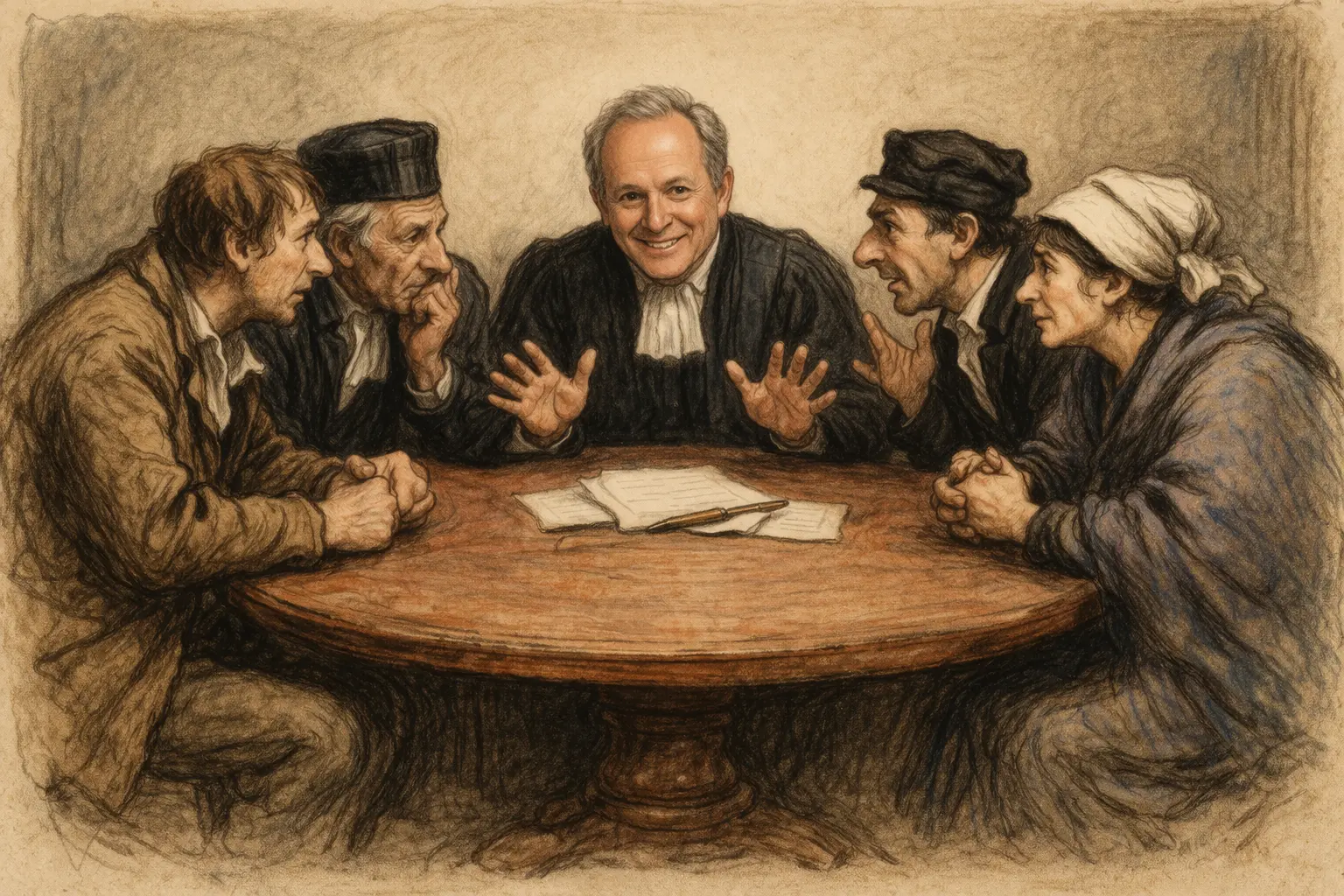
Arbitration, Mediation, Confidentiality: Statements Of Director, Who Had Served As Mediator And Arbitrator, Are Admissible In Evidence
Trial Judge Parsed Declaration To Determine Whether Statements Were Made By Judge DickranTevrizian (Ret.) In Capacity As Mediator, Arbitrator, Or Director.
When an opinion begins, "Leo Tolstoy famously observed that every unhappy family is unhappy in its own way," you can be sure that you are in for a dismal tale. And the reader's expectations would not be disappointed in the case of Drake Kennedy v. Brian Kennedy & Regency Outdoor Advertising, Inc., B294398 (2/1 7/26/19) (Weingart, Johnson, Bendix) (unpublished). The case is part of the ongoing saga of the internecine legal strife between brothers Drake and Brian Kennedy, stemming from the family billboard business they co-own. The substance of this case concerns brother Drake's obtaining of an order appointing a receiver for sale of the family business, affirmed on appeal.
But it is not the substance of this case with which this post is concerned. Nope, we're focused on a narrow evidentiary issue concerning mediators, arbitrators, and confidentiality.
Judge Tevrizian had been appointed as a third director, presumably to avoid board statelemate of brothers Drake and Brian, and to help with the sale of the brothers' business. "Given Brian's repeated refusal to respect the board's oversight role, Judge Tevrizian resigned as a director as of September 25, 2018. The resignation was 'noisy,' that is, accompanied by an explanation of reasons set forth in the board minutes . . . " Those reasons included inability to obtain financial information, inability to get access to company books and records, refusal of management to comply with requests for information; and, "disrespect and lack of appreciation exhibited by senior management of the Company . . . " Once Judge Tevrizian resigned, the board was again deadlocked.
Judge Tevrizian's statements — some of them — were admitted into evidence. Brother Brian objected that Judge Tevrizian's declaration should have been excluded, because Evid. Code section 703.5 prohibits arbitrators and mediators from testifying "as to any statement, conduct, decision, or ruling, occurring at or in conjunction with" an arbitration or mediation "in any subsequent civil proceeding." And, "Section 1121 prohibits mediators or anyone else from submitting to a court, and a court from considering, 'any report, assessment, evaluation, recommendation, or finding of any kind by the mediator concerning a mediation conducted by the mediator,' . . . "
In fact, Judge Tevrizian had also acted as a mediator/arbitrator. But the trial court parsed the declaration, striking statements related to Tevrizian's role as an arbitrator or mediator, and "expressly noted it was receiving the remaining portions because they related to Judge Tevrizian's role as a company director."
The lesson we draw from this (albeit unpublished) opinion is that if the court can sort out the different roles a person may play, and determine which statements were not made in that person's capacity as a mediator or arbitrator, then the remaining statements may be admissible in evidence. The Court of Appeal rejected the argument that the statements made by Judge Tevrizian in his different roles were so inextricably intertwined that they could not be sorted, and thus rejected the argument that the statements were cloaked in privilege. If Judge Tevrizian's roles and statements could not have been separated and sorted, then the outcome on the evidentiary issue could have been different.

William Blake. The Body of Abel Found by Adam and Eve. 1826. Wikimedia Commons. Public Domain.
Arbitration, Agency, Enforceability, Section 1281.2: Nursing Facility Is Unable To Enforce Arbitration Provision Because Children’s Claims Were Not Subject To Arbitration
And Prospect Of Inconsistent Results Meant Father's Claims Could Not Be Arbitrated While Children's Claims Were Litigated.
Nursing homes continue to be a fertile source of cases concerning the enforcement of arbitration clauses. This is not surprising, because a patient, especially an elderly patient, who enters a nursing facility may be infirm or incompetent; when the patient enters the home, i's may not be dotted and t's may not be crossed; and, bad things can happen in nursing homes. The latest published California opinion involving a nursing home and the enforceability of an arbitration provision is Valentine v. Plum Healthcare Group, LLC, et al., C080940 (3rd Dist. 7/25/19) (Raye, Hull, Hoch). Valentine combines certain of the factual elements that seem to lead to enforceability of arbitration issues: an elderly patient who may be confused, arbitration provisions, and a terrible medical outcome.
In Valentine, a woman was admitted to a nursing home. Her husband handled the paperwork, signing documentation providing for arbitration of his claims as successor and as individual. As a result of alleged neglect, the woman's condition deteriorated, resulting in sepsis, and she died of cardiac arrest.
The trial court held that the husband did act as an agent to bind his wife, because evidence did not show she had created an agency. However, the husband was bound by arbitration agreements to arbitrate his claims as an individual and as a successor to his wife's claims. But the children, who were not parties to an arbitration agreement, were not bound to arbitrate their individual claims for wrongful death or for negligent infliction of emotional distress. Because arbitration of the husband's claims, which were subject to a valid arbitration clause, could have led to inconsistent results if the children's claims were separately litigated, the trial court acted within its discretion when it denied a petition to arbitrate pursuant to CCP section 1281.2. AFFIRMED.
![[Florence Nightingale]](https://cdn.loc.gov/service/pnp/ppmsca/57100/57163r.jpg)
Florence Nightingale. c1856. Library of Congress.
Miscellaneous: Gone On A Trip . . . Back Again
We Took A Break From Blogging . . .
I have been absent for a couple of weeks, during which time I traveled to Italy for a family wedding. Fortunately, there has been a dearth of California opinions on mediation and arbitration during my absence. Here are two photos from my trip:
Monterosso al Mare in Cinque Terre.
Somewhere near Salsomaggiore Terme.
Arbitrator, Confidentiality, Disclosures, Discovery, Unconscionability: Former Employee Advanced No Meritorious Reasons For Why An Employment Agreement Was Unconscionable
Also, Arbitrator’s Religious Affiliation Is No Reason For Disqualification, With Jewish Affiliation Not Showing Any Inherent Bias Against Homosexuals.
Bogue v. Anesthesia Service Medical Group, Inc., Case No. D073518 (4th Dist., Div. 1 July 17, 2019) (unpublished) (McConnell, P.J.; Benke, J.; and Irion, J.) is a case where a former employee lost an arbitration against a former employer, with the arbitration award being confirmed by a superior court judge. Plaintiff’s claims primarily consisted of whistleblower retaliation and FEHA claims, mainly focused on the allegations that employer discriminated against employee because he was a homosexual. The arbitrator summarily adjudicated out the whistleblower retaliation claim and found against plaintiff on the merits in a detailed arbitration award. On appeal, plaintiff principally claimed that the parties’ arbitration agreement was unconscionable and that the arbitrator, who was Jewish, was prejudiced against homosexuals in general.
The Fourth District, Division 1, affirmed the confirmation of the arbitration award.
With respect to the claim that the arbitration agreement was unconscionable, the appellate court found no substantive unconscionability in these respects: (1) the arbitration agreement contained no limitations on discovery and the ADR provider rules had no similar restrictions; (2) the arbitration agreement did provide for a written award consisting of a concise statement of reasons supporting the award and explaining the basis for a decision on a statutory claim, which more than sufficed; and (3) the arbitration agreement had no confidentiality ban, but the ADR rules did not restrict the litigants from publicly discussing the arbitration, which actually was done through the appeal.
The appellate court was not impressed with the religious affiliation disqualification claim against the arbitrator. Religious affiliation is not a sufficient ground by itself to require disqualification of an arbitrator. (Code Civ. Proc., § 170.2.) One cannot reasonably presume, because an arbitrator is Jewish, that the arbitrator has any faith-based animosity toward homosexuality or homosexuals. “Moreover, many people of faith, including arbitrators and judges, engage in professions requiring them to make decisions based on standards separate from and not necessarily aligned with the tenets of their faith. As long as an arbitrator is able to base his or her decision on the evidence and the applicable law, regardless of the tenets of his or her faith, the arbitrator is not required to disclose his or her faith-based memberships.” (Slip Op., at p. 13.) Furthermore, the arbitrator did include a CV showing his Jewish affiliations such that the failure to seek the arbitrator’s disqualification before the arbitration took place forfeited the losing party’s right to disqualify the arbitrator on that basis.
We note that a similar opinion was published back in 2011, involving a disgruntled party in arbitration and a Jewish arbitrator. Rebmann v. Rohde, 196 Cal. App. 4th 1283 (2011). The defendant/appellant informed the trial court that if only he had "known about his [the arbitrator's] religious affiliation, his cultural affiliation, and the dedication to keeping the memory of the Holocaust alive, I never would have allowed him to be the arbitrator in my case." The defendant/appellant's father, and his wife's father served in the SS during WWII. Among other things, the Court of Appeal rejected the "tacit assumption" that "a judge who is a member of a minority cannot be fair when a case somehow related to that minority status – no matter how remote or tenuous that relationship might be – comes before that judge." We posted about this on Mike & Marc's California Attorney's Fees blog on July 5, 2011. Efforts to disqualify judges and arbitrators based on religion and race do not succeed.
Arbitration, FAA: Ninth Circuit Holds Federal Arbitration Act Does Not Preempt California’s McGill Rule
McGill v. Citibank Held Agreement To Waive Right To Seek Public Injunctive Relief Is Unenforceable.
In McGill v. Citibank, N.A. (2017), the California Supreme Court held that a contract purporting to waive a party's right to seek public injunctive relief in any forum is unenforceable under California law. The key issue in Blair v. Rent-A-Car, No. 17-17221 (9th Cir. 6/28/19) (Fletcher, McKeown, Murguia), is whether the Federal Arbitration Act preempts California's McGill rule. The Ninth Circuit holds that the FAA does not preempt the McGill rule.
Blair brought a putative class action against the Rent-A-Center defendants, alleging they overcharged for rent-to-own plans for household items. Such plans provide for installment payments, and if all payments are timely made, the consumer owns the item. Blair's agreement contained an arbitration clause providing that it was "intended to be interpreted as broadly as the FAA allows." The agreement also provided that arbitration was to be on an individual basis and relief could not affect other account holders. There could be no class, collective, mass, private attorney general, or representative action. If the provision was held to be unenforceable, then the claims for relief had to be severed and brought in a judicial forum.
The district court concluded that this agreement violated the McGill rule because it waived Blair's right to seek public injunctive relief in any forum (1) because all claims had to be heard in arbitration; and (2) because claims for public injunctive relief could not exist in arbitration consistent with the parties' agreement. The Court of Appeals agreed, and severed the claims providing for public injunctive relief, which will now be heard in court.
The court analyzes federal preemption in two steps. First, it explains the McGill rule is a "generally applicable contract defense." In other words, it applies equally to arbitration and non-arbitration agreements. In contrast, a rule that uniquely burdens arbitration would be preempted by the FAA. Second, even a generally applicable contract defense may not prevent preemption, if the rule interferes with the accomplishment of the FAA's objectives. However, the McGill rule does not deprive the parties of the benefits of arbitration, because according to the Blair court, a public injunctive relief claim could be sought in arbitration or in court. And seeking a public injunction in arbitration does not require all the procedural formality that a class action would require.
Here, however, the parties' agreement precluded the pursuit of a public injunction in arbitration, and triggered severance of public injunctive relief claims — so such claims will go to the district court.
COMMENT: In Blair, the claims for public injunctive relief are severed and go to court only because the agreement does not allow such claims to be heard in arbitration. But an agreement could be drafted that would allow for a hearing of such claims in arbitration. How much protection would that give to the public?
It would seem that the interests of the public would be better served by hearing public injunctive relief claims in court, because mistakes of law and fact made by an arbitrator would be no basis for vacating the award. While that is exactly what private parties should expect, in the case of public injunctive relief, broader interests are at stake. If one could write on a blank slate, the public's interests would be better protected by a court hearing than by arbitration. But one does not write here on a blank slate.
Recommended Reading: Article On Participation Waivers In Daily Journal
A "Participation Waiver" Is Not Exactly The Same As A Waiver Of The Right To Sue Or A Bar Against Bringing A Class Action.
Ari J. Stiller, an attorney with Kinglsey & Kingsley, has an article in the June 26, 2019 issue of the Daily Journal entitled, "Participation waivers test Federal Arbitration Act's limits."
As Stiller explains, "So-called 'participation' waivers don't just try to bar employees from bringing a class or collective action in arbitration; they bar participating in such an action that someone else brings, regardless of the forum." Stiller argues that this is a bridge too far, and that once a lawsuit is filed by a party who is not bound by an arbitration agreement, the procedural rules applicable to court should apply. "Courts should not enforce such [participation] waivers outside of arbitration," argues Stiller, "to deny discovery or class certification, and certainly not to prevent workers from participating in a classwide recovery of unpaid wages."
I asked Stiller whether there are cases specifically addressing "participation waivers" and he replied that he did not know of any, adding: "We have litigated this issue several times recently, in the context of employers trying to block discovery as to individuals who signed participation waivers and an employer trying to strike class allegations from a complaint." So this issue is a live one, even if published opinions have not yet confronted the enforceability of "participation waivers."