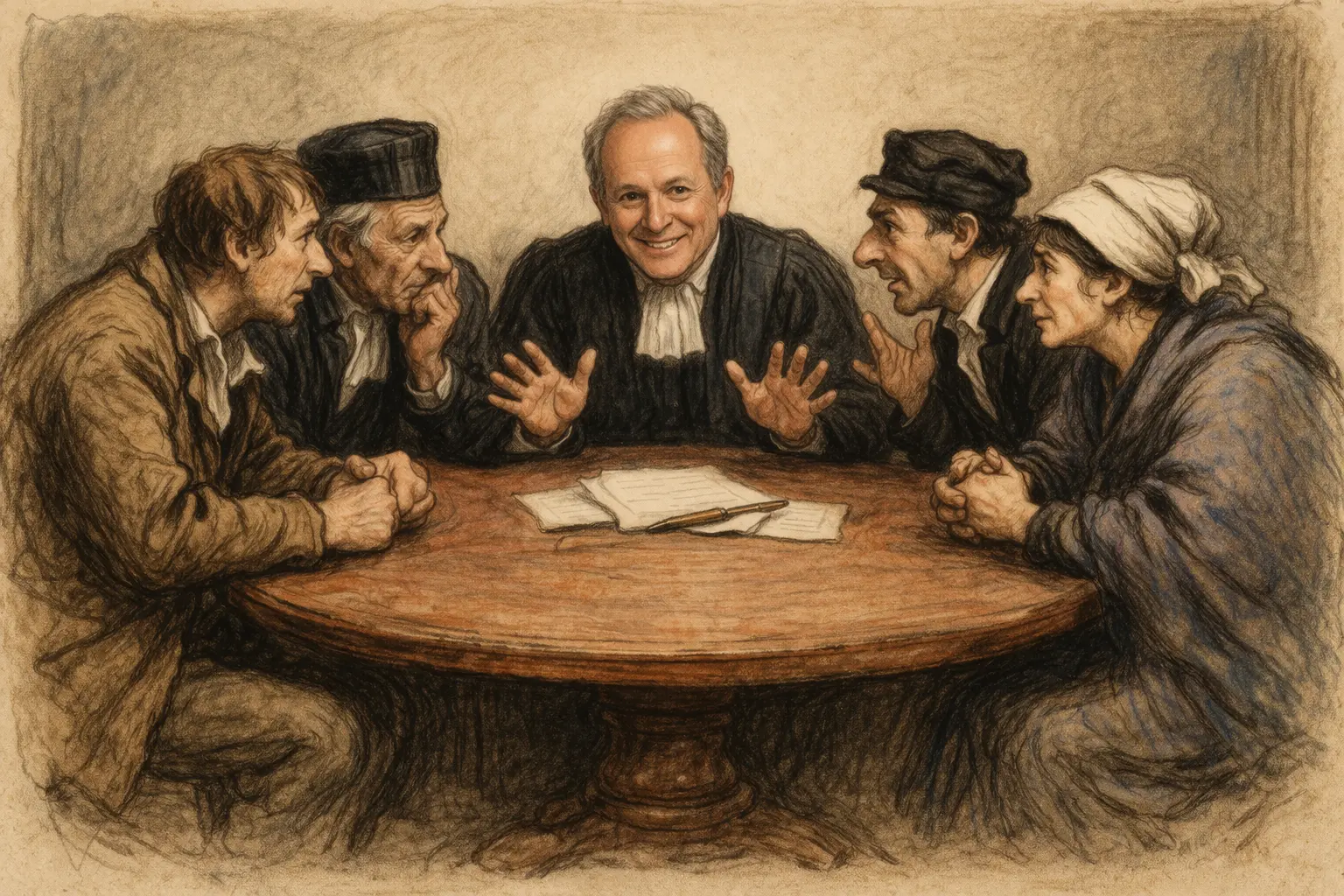
Miscellaneous: On The Exchange Of Briefs In Mediation
Recommended Reading: "Exchanging mediation briefs: the simplest path to success".
Mediators often urge that counsel exchange mediation briefs, but an actual exchange seems more to be the exception than the rule. Mediator Robert M. Cohen has a column in the May 24, 2022 Daily Journal advocating for the exchange of briefs in mediation. In a nutshell, his argument is that great communication is the key to successful mediation, and exchanging briefs is the simplest way to further great communication. I have provided a link to the article. The Daily Journal is behind a paywall, but readers with access and an interest in mediation will benefit by reading his column.
As a mediator, I acknowledge that the process is voluntary and I can't compel attorneys to exchange briefs. But I also urge the exchange of briefs, with the proviso that information that is truly confidential and not to be shared with the other side can be removed from the brief and still shared with the mediator. I also ask that the attorneys discuss whether they will exchange briefs, because I hope to avoid a situation in which one attorney provides a brief to the opposing attorney, and the opposing attorney does not reciprocate. In such circumstances, the attorney providing the brief may feel ambushed. However, an attorney who believes the client's position is strong may choose to unilaterally provide a brief to the other side, and the failure of an attorney to reciprocate is sometimes perceived as a sign of weakness.
Arbitration, Delegation, Choice Of Law: Sixth District Affirms Denial Of Motion To Compel Arbitration Because There Was No Agreement To Arbitrate
Whether An Arbitration Agreement Exists Was A Gateway Issue For The Court To Decide.
Agreeing with the trial court that there was no agreement express or implied to arbitrate, the Court of Appeal affirms the trial court's order denying employer's motion to compel arbitration in a putative class action wage and hours case brought by a trucker. Mendoza v. Trans Valley Transport et al., H044372 (6th Dist. 3/1/22) (Greenwood, Elia, Grover). This is a 55-page opinion and I will be brief.
First, the opinion addressed choice of law: did the California Arbitration Act or the Federal Arbitration Act apply? Answer: the CAA applied, because of the carve-out in the FAA for "workers engaged in foreign or interstate commerce," meaning transportation workers. And Mr. Mendoza fell into the carve-out category because he was a trucker. Therefore, the CAA applied.
Second, the Court of Appeal refused to enforce a delegation clause delegating the issue of contract formation to an arbitrator. It found the issue to have been forfeited because it was only raised in reply papers. Nevertheless, addressing the merits, the Court concluded that not all gateway issues are delegable, and the issue of whether an agreement to arbitrate existed was one for the courts to decide.
Third, the Court agreed that the parties had not agreed to arbitrate. The problem was that, while the employee acknowledged receipt of a handbook and 14 other items, and acknowledged that any questions he had were answered, nothing in the mass of documents pointed him to an arbitration clause, and there was no signature line for the arbitration policy that could have been found in the handbook. Nor would the Court conclude that there was an "implied in fact" contract, simply because the employee received the handbook and continued to work for the company, because nothing drew the employee's attention to the arbitration policy.
COMMENT: Employers who want to make an arbitration agreement "stick" should include signature lines, and make it clear and unmistakable in writing to the employee that the employee is agreeing to arbitrate. We note that Mendoza was Spanish speaking and did not read or write English. The employer's director of human resources testified that his custom and practice was to explain the written material to employees and that a Spanish translation was provided, which, however, Mendoza did not recall. For employees who may not be fluent in English, it is preferable to have clear and unmistakable evidence that they have received a written translation.
Arbitration, Unconscionability: Second District Div. 4 Affirms Trial Court’s Holding Of Unconscionability, While Disagreeing On One Point With Brethren In Div. 7
The Dispute With District 2, Div. 4, Involved The Reasoning In Patterson v. Superior Court, 70 Cal.App.5th 473 (2021) (Patterson).
The Court of Appeal affirmed the trial court's court denying Charter's motion in compel arbitration. Ramirez v. Charter Communications, Inc., B309408 (2/4 3/1/22) (Willhite, Manella, Collins). The Court held that the arbitration provisions were unconscionable: the employment contract was one of adhesion; the was a shortened statute of limitations; an interim award of attorneys fees provision was unconscionable; the arbitration agreement was unfairly one-sided because it compelled arbitration of claims more likely to be brought by an employee, the weaker party; a limitation on depositions made it harder for the employee to prove her case.
The noteworthy part of the Ramirez opinion concerns the panel's critique of District 2 Division 7's reasoning in Patterson. The court in Patterson "considered the enforceability of a provision in the same arbitration agreement at issue here that awards attorney fees to the prevailing party on a motion to compel arbitration." The problem with such a provision is that FEHA entitles the prevailing defendant to attorney fees only if the employee’s action was "frivolous, unreasonable, or groundless," and that limitation is not found in Charter's arbitration provisions. In Patterson, however, the court imported the FEHA provision into the attorney's fees provision in order to save the provision. The court in Ramirez disagrees with the Patterson approach, construing the attorney's fees provision to be unambiguous, and therefore not subject to interpretive tinkering.
Arbitration, Appealability, Jurisdiction, Celebrities: Second District, Div. 7 Declines To Consider Interim Award Of Preliminary Injunctive Relief
Interim Rulings By An Arbitrator Are Not Reviewable Until A Final Award Is Issued.
Charlotte Kirk, an actress, entered into a confidential settlement agreement in 2017 with four men who were entertainment industry executives. The agreement contained an arbitration clause. Claiming that Kirk violated the settlement agreement, the executives filed an arbitration demand naming Kirk, her fiance Neil Marshall, and two other respondents, and obtained from an emergency arbitrator injunctive relief to enforce confidentiality provisions and to prevent the filing of a lawsuit that would make confidential information public. Kirk and respondents filed a petition in superior court to vacate the preliminary injunction. The court denied the petition because the preliminary injunction was not an appealable final award, and the Court of Appeal affirmed. Kirk v. Ratner, B309880 (2/7 2/10/22) (Perluss, Segal, Feuer).
Cases teach that, "in the context of a series of rulings . . . a particular ruling is an ‘award’ only if that ruling (1) ‘determine[s] all issues that are necessary to the resolution’ of ‘“the controversy”’ being subject to arbitration, and (2) leaves unresolved only those ‘issues’ that are ‘potential,’ ‘conditional’ or that otherwise ‘could not have been determined’ at the time of the ruling.” In Kirk, the Court of Appeal concluded that there was no "award."
COMMENT: Apparently the confidential settlement agreement in Kirk settled, among other things, "Kirk’s claims of sexual harassment, infliction of emotional distress and defamation." Perhaps this explains why the entertainment executives did not want the allegations appearing in public pleadings. And there may have been other motives for keeping other information confidential, e.g., whether money changed hands as part of the settlement, and if so, how much money. These are common reasons for moving claims of sexual harassment into arbitration, and cloaking the arbitration proceeding in confidentiality. In February 2022, Congress moved to end forced arbitration of sexual assault and sexual harassment claims by amending the Federal Arbitration Act. See the February 17, 2022 post by the Procopio law firm.
Arbitration, Scope, Stay: Fifth District Agrees Equitable Issues Were Outside Scope Of Arbitration Agreement, And Arbitrable Claims Could Be Stayed
The Arbitration Provision Was Not Ambiguous.
The arbitration provision in Eminence Healthcare, Inc. v. Centuri Health Ventures, LLC, et al., F079993 (5th Dist. 2/2/22) (Franson, Hill, Pena), carved out equitable causes of action from arbitration. Because the Court of Appeal agreed the clause was unambiguous, the Court affirmed the trial court's decision that six equitable claims should be heard by the trial court. In an unpublished part of the opinion, the Court of Appeal agreed that the arbitration of the remaining arbitrable claims was properly stayed because the resolution of the litigated claims might dispose of the need to arbitrate.
Arbitration, Construction Of Scope Of Agreement: Second Dist.Div. 7 Reverses Arbitration Award Because Narrow Scope Of Arbitration Agreement Did Not Cover The Dispute
The Court Of Appeal Construes The Arbitration Provision As "Narrow" Rather Than "Broad."
The Court of Appeal reverses confirmation of an arbitration award in Thomas Ahern et al. v. Asset Management Consultants, Inc., et al., B309935 (2/7 2/1/22) (Perluss, Segal, Feuer).
The underlying dispute was between a co-tenant, Ahern, who purchased a co-tenant interest in an office building from Asset Management Consultants, who acquired the building from iStar. Asset Management Consultants compelled arbitration against Ahern based on an arbitration provision in the co-tenancy agreement. This was reversed on appeal, because Ahern's dispute with Asset Management Consultants did not "arise under" the co-tenancy agreement. The dispute related to representations made during the acquisition of the building, not to the management and operation of the building under the co-tenancy agreement.
Arbitration clauses requiring a dispute to "arise under" an agreement are interpreted to be narrower in scope than clauses providing for arbitration of "any dispute" or clauses providing for disputes "arising from or related to" an agreement. The clause at issue here was construed to be a narrow one.
COMMENT: It seems that Ahern will get another bite out of the apple. But we don't know whether a judge will rule differently on the merits of the underlying dispute, or whether the reversal of fortune will lead to a settlement.